

Javan Rhino extinction Cat Tien is not just a historical event. It is the defining ecological lesson of southern Vietnam’s most important lowland forest. Every patrol route, every guard station, every conservation discussion in the park today traces back to that permanent absence.
The local extinction of the Javan Rhinoceros in Cat Tien exposes the extreme fragility of small, isolated populations and demands a structural shift toward uncompromising protection of the remaining megafauna—particularly Asian Elephants and Gaur. This is not a story of nostalgia or symbolic loss. It is a lesson written in ecological mathematics, enforcement failure, and the irreversible cost of waiting too long to act.
A Landscape That Once Held a Rhino
To understand conservation gravity in Cat Tien, one must begin with the disappearance of the Vietnamese Javan Rhinoceros (Rhinoceros sondaicus annamiticus). Historically, this subspecies roamed widely across mainland Southeast Asia, inhabiting lowland tropical forests, riverine floodplains, and mosaic bamboo systems.
By the late twentieth century, hunting pressure and habitat conversion reduced its distribution to fragments. Vietnam’s last survivors persisted in what is now the Cat Loc sector of Cat Tien National Park—a hilly northern extension of the main Nam Cat Tien block.
In 1988, a small population was rediscovered in Cat Loc. This rediscovery triggered international conservation mobilization. The Cat Loc rhino sanctuary was formally integrated into the national park system with one singular objective: prevent extinction.

For over two decades, Cat Tien and Ujung Kulon in Indonesia were the only two places on Earth where Javan Rhinos survived. Funding flowed. International NGOs collaborated. Patrol units were formed. Monitoring intensified.
Yet despite these efforts, the population declined steadily.
The phrase “Javan Rhino extinction Cat Tien” now defines that outcome. It marks Vietnam as the first country in the 21st century to lose a large mammal species to extinction.
This is not merely a tragedy. It is the baseline for all present-day conservation strategy.
Extinction Happens Before the Last Shot
The disappearance of the rhino was not caused solely by the single poacher’s bullet discovered in 2010. That bullet was the final punctuation mark, not the main sentence.
The core insight emerging from the conservation failure Cat Tien experienced is this:
“Intervention cannot wait until a population reaches a critical bottleneck.“
By the time the final individual was killed, the population had already collapsed demographically and genetically. The rhinos were too few, too isolated, and too fragmented to recover.
This is where the Allee Effect conservation principle becomes central. The Allee Effect describes how populations below a certain threshold experience declining reproductive success simply due to low density. When individuals cannot find mates, when genetic diversity collapses, when breeding intervals stretch beyond viability—the population is biologically doomed even before external mortality occurs.
In Cat Tien, by the mid-2000s, the rhinos had likely entered this “living dead” phase. They were alive individually but extinct functionally.
The extinction was mathematical before it was ballistic.
How It Unfolded
1. The “Living Ghost” Population
Early field estimates suggested 10–15 individuals. However, more rigorous monitoring conducted by the Rhino Patrol and Monitoring Unit (RPMU) through footprint analysis and DNA sampling painted a darker picture.
Later assessments revised the population to a maximum of 2–6 individuals, with the most realistic estimate being around three.
More critically, no signs of breeding were recorded for at least seven years prior to extinction. No juvenile footprints. No juvenile dung. No genetic evidence of recruitment.

A population without reproduction is functionally extinct.
Fecal DNA analysis conducted between 2009 and 2010 revealed that the final surviving individual was a single female living alone.
This is the biological reality behind Javan Rhino extinction Cat Tien:
a solitary animal in a fragmented forest, genetically isolated, ecologically cornered.
2. The Encroachment Trap
The rhinos were confined to approximately 5,000 hectares in Cat Loc.
This was insufficient for a viable megaherbivore population.
Agricultural encroachment and village expansion inside the core zone fragmented habitat further. Movement corridors shrank. The rhinos were effectively fenced in by human presence without physical fences.


©: World Wide Fund For Nature (WWF)
Fragmentation increases edge effects, poaching risk, and resource limitation. It also amplifies Allee Effect dynamics.
This was not just a population decline. It was spatial compression.
3. The Final Blow
In April 2010, the carcass of the last Javan Rhino was found with a bullet wound in the leg. The horn had been removed.
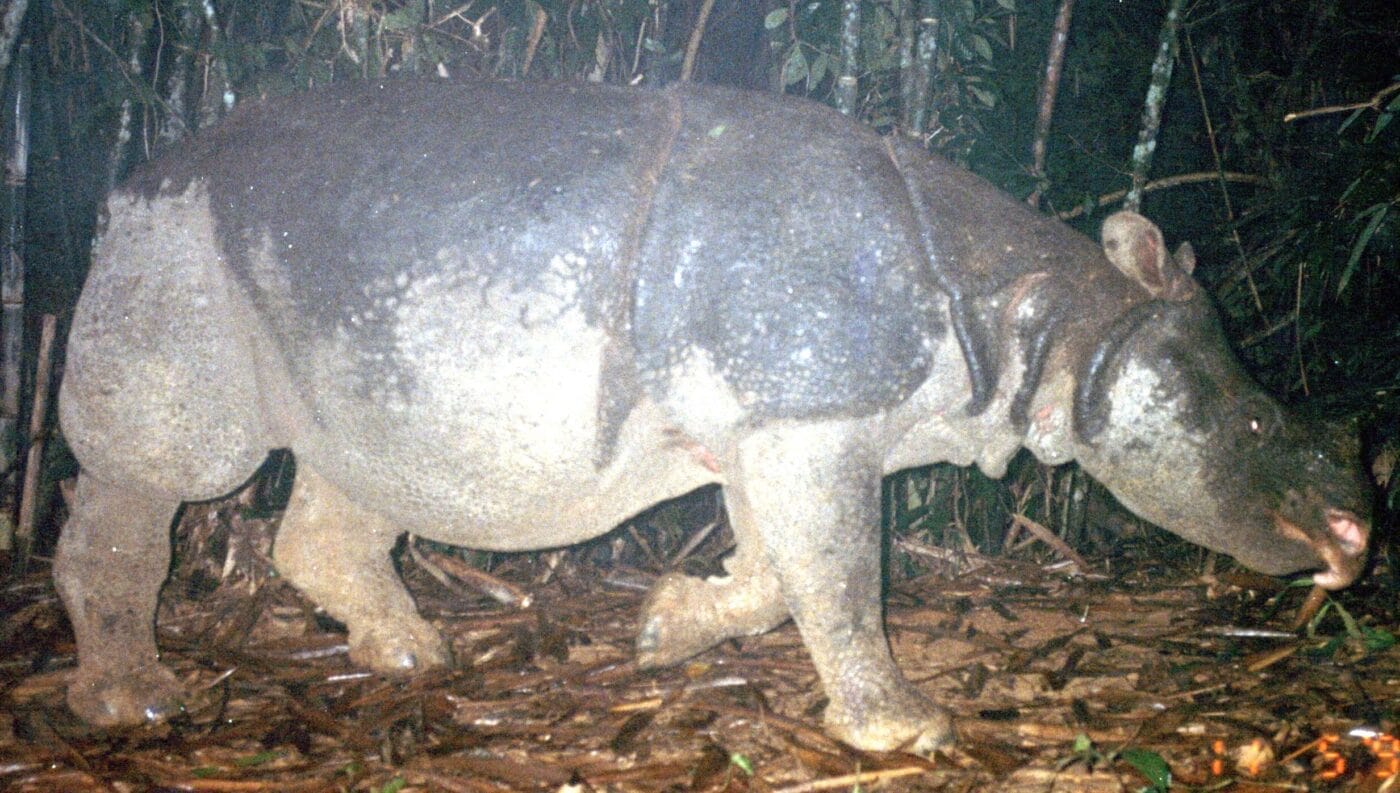
©: Collect
The official confirmation sealed the phrase Javan Rhino extinction Cat Tien into conservation history.
Despite protected status, despite patrol units, despite global attention—the enforcement grid had remained porous enough for an armed hunter to locate and kill the rarest mammal in Vietnam.
Protection existed on paper. On the ground, it was not yet sufficient.
The Museum Skeleton: A Physical Baseline of Loss
Visitors today encounter the rhino not in forest silence but inside the museum at park headquarters. The reconstructed specimen—often referred to informally as the Javan Rhino skeleton museum Cat Tien exhibit—stands as an educational monument.
Bone structure reveals evolutionary engineering millions of years in the making. Massive limb columns. Armor-like dermal folds. A body adapted to dense lowland forest browsing.

©: Cat Tien National Park
Now reduced to skeletal form.
The exhibit does not dramatize. It educates.
For field guides, this skeleton functions as a conservation baseline. It demonstrates that extinction is not theoretical. It happened here. Recently.
The absence in the forest is real.
From Failure to Enforcement: SMART Patrol Rigor Cat Tien
The rhino’s disappearance fundamentally reshaped operational strategy.
Modern patrol systems now integrate SMART patrol rigor Cat Tien protocols. The Spatial Monitoring and Reporting Tool (SMART) allows rangers to:
- Log patrol tracks digitally
- Record snares and illegal activities
- Map hotspots
- Analyze enforcement coverage gaps

©: Save Vietnam’s Wildlife (SVW)
When visitors encounter ranger checkpoints or hear about patrol rotations, they are observing a direct institutional response to the conservation failure Cat Tien experienced.
The rhino’s “ghost” drives stricter enforcement for remaining megafauna.
The system today is designed to prevent repetition.
The Shift in Focus: Gaur and Asian Elephant Protection
With rhinos gone, conservation urgency pivots toward species that remain viable—but vulnerable.
Gaur (Bos gaurus)
As the largest wild bovine on Earth, Gaur represent the next massive herbivore at ecological risk. Herd fragmentation, human disturbance, and habitat compression pose ongoing threats.

Protection strategies now emphasize:
- Anti-poaching patrol density
- Corridor integrity
- Monitoring herd movement
Asian Elephants (Elephas maximus)
The Asian Elephant population in Cat Tien faces:
- Habitat fragmentation
- Human-elephant conflict
- Reduced genetic exchange

©: Nguyen Van Cuong
The lesson from Javan Rhino extinction Cat Tien is clear:
Intervention must occur while populations are still reproductively viable.
Gaur and Asian Elephant protection efforts now operate under stricter scrutiny precisely because the rhino’s trajectory showed what happens when action lags behind demographic warning signs.
Cat Loc: A Landscape That Failed
The Cat Loc sector still exists. Bamboo stands mix with secondary forest patches. Terrain undulates. River systems dissect the hills.
But ecological visualization reveals what historical maps confirm:
The area was too small.
Too pressured.
Too isolated.
For megafauna, spatial scale determines survival probability.
Standing in Cat Loc today is not standing in mystery. It is standing in evidence.
The Allee Effect in Practice
The Allee Effect conservation principle moves from textbook abstraction to field reality in Cat Tien.
When population size drops:
- Mate encounter rates decline
- Genetic diversity erodes
- Inbreeding depression increases
- Calf survival probability drops
- Recruitment stops
Once recruitment stops, extinction clock accelerates.
The rhino population likely crossed this threshold years before the final individual died.
That is why the extinction was predictable.
Governance After Loss
The extinction also influenced governance standards.
Management reforms intensified. External audits increased. Transparency improved.
The park’s pursuit of higher international conservation benchmarks was partly shaped by the rhino’s disappearance. Institutional credibility required demonstrable management effectiveness.
Conservation became not only ecological but reputational.
What Visitors Must Understand
This Knowledge Asset confirms one unavoidable truth:
No visitor will see a Javan Rhino in Cat Tien.
Outdated guidebooks or older online articles may still reference “rare rhinos.” These are obsolete relics of a past era.
The rhino story is not a marketing tool. It is not a myth. It is an admitted conservation failure Cat Tien openly acknowledges.

Sharing this history serves educational, not promotional, purpose.
From Tragedy to Responsibility
The extinction reframes how megafauna are viewed.
Attention must now remain firmly on:
- Gaur and Asian Elephant protection
- Habitat connectivity
- Enforcement density
- Long-term genetic viability


These species are currently positioned where the rhino was decades ago—threatened but still salvageable.
Ethical tourism, informed visitors, and sustained patrol funding form part of the protection web.
The skeleton in the museum is not the end of a story. It is a warning label.
Biogeographical Significance
Cat Tien’s lowland forest system once served as the last mainland stronghold for the Javan Rhino.
This biogeographical isolation explains both the rediscovery in 1988 and the eventual collapse.
Lowland tropical forests across Southeast Asia have been disproportionately converted. Cat Tien’s remnant status made it both refuge and trap.
Isolation preserved the species temporarily—but also prevented demographic rescue.
Permanent Absence as Ecological Baseline
In ecological systems, absence reshapes structure.
The rhino was a megaherbivore browser. Its feeding likely influenced understory structure, seedling competition, and bamboo dynamics.
While exact ecosystem engineering roles remain debated due to limited population size in later decades, megafauna removal rarely occurs without cascading consequences.
The forest adjusted.
But adjustment does not equal restoration.
The Lesson for Remaining Mega-fauna
The phrase Javan Rhino extinction Cat Tien should not be spoken in past tense alone. It should function as ongoing policy guidance.
For Gaur:
- Maintain herd cohesion
- Prevent snaring
- Protect water access
For Asian Elephants:
- Secure corridors
- Reduce human conflict
- Preserve genetic exchange
For enforcement:
- Maintain SMART patrol rigor Cat Tien standards
- Close spatial coverage gaps
- Sustain funding continuity

Conservation delay compounds risk.
Limits, Non-Fit & Ethics
- Irreversible Loss: The rhino will not return. No reintroduction program currently exists for Vietnam.
- Not a Marketing Narrative: This story is shared as accountability, not spectacle.
- Educational Purpose: The extinction informs field interpretation and visitor awareness.
- Responsibility Shift: Remaining megafauna now carry the urgency once attached to the rhino.
Extinction is not abstract. It occurred within a protected area bearing international recognition.
Knowledge Integration
This Knowledge Asset connects to broader themes:
- Ungulate Ecology: Understanding Gaur dynamics under strict protection.
- Biogeographical Significance of Cat Tien: Why lowland refugia matter.
- Cat Tien as a Living Lowland Forest System: Habitat context once engineered by rhinos.
Each link reinforces the structural lesson: ecological systems require proactive scale, not reactive sympathy.
Conclusion: A Forest That Remembers
TThe forest floor no longer holds rhino footprints. Patrol logs no longer record dung DNA. Night silence no longer carries the movement of a heavy-bodied browser pushing through bamboo. Yet the absence structures everything.
Javan Rhino extinction Cat Tien reshaped enforcement philosophy, redefined megafauna priorities, and permanently embedded the Allee Effect principle into conservation management. The skeleton displayed in the museum is not simply bone—it represents policy, accountability, and ecological mathematics made visible. It defines the moral boundary within which Gaur and Asian Elephant protection must now operate. The remaining giants still walk, but their future depends on acting before numbers fall into silence.
At WANEE, conservation is understood as something that must extend beyond protected area boundaries and into the choices people make when they travel. WANEE operates ecotourism programs grounded in field knowledge, scientific integrity, and strict wildlife ethics, always guided by a clear belief: tourism can become a powerful tool for conservation. By transforming forest visits into informed, responsible experiences, WANEE helps channel awareness, funding, and long-term commitment directly toward protecting the species that remain. Learn more about WANEE’s conservation-driven journeys here: https://wanee.asia/cat-tien-tours/