

Cat Tien National Park is not a place where wildlife is measured by how easily it can be seen. It is a living lowland rainforest system, where the most important animals are often the least visible. Among the hundreds of species recorded here, four large mammals stand out—not because they are common, but because they shape the ecological backbone of the forest. Collectively, they are known as the Cat Tien Big Four, a concept rooted in ecological importance rather than visibility.
Each of these species represents a different forest layer, ecological role, and conservation challenge. Together, they form a foundation without which Cat Tien would no longer function as a healthy lowland rainforest.
A Shared Home – The Lowland Forest Ecosystem of Cat Tien
Cat Tien lies within one of the last remaining lowland evergreen forests in southern Vietnam. Seasonal rivers, wetlands, bamboo patches, and tall dipterocarp trees create a mosaic of habitats that support complex food webs.
Large mammals are critical in this system. They move seeds, shape vegetation, control population balance, and act as umbrella species – protecting them means protecting entire ecosystems beneath them. The Big Four are not just animals living in Cat Tien; they are architects of the forest itself.
A. Asian Elephant (Elephas maximus): The Forest Engineer
The Asian Elephant once ranged widely across southern Vietnam. Today, small, fragmented populations remain, and Cat Tien represents one of the most important landscapes still capable of supporting them.
Elephants are often described as ecosystem engineers, and in Cat Tien this role is unmistakable. As they move through the forest, they open pathways, create clearings, and disperse large seeds that no other animal can transport. Many tree species depend on elephants to regenerate across distances.


In Cat Tien, elephants are extremely elusive. Sightings are rare, but their presence is known through footprints, broken vegetation, and dung. These signs tell a deeper story: even unseen, elephants are shaping the forest structure.
Conservation here is not just about protecting elephants from poaching. It is about managing human–wildlife conflict at the forest edges and maintaining habitat connectivity. The survival of elephants in Cat Tien reflects the health of the entire lowland ecosystem.
B. Gaur (Bos gaurus): Strength of the Forest Floor
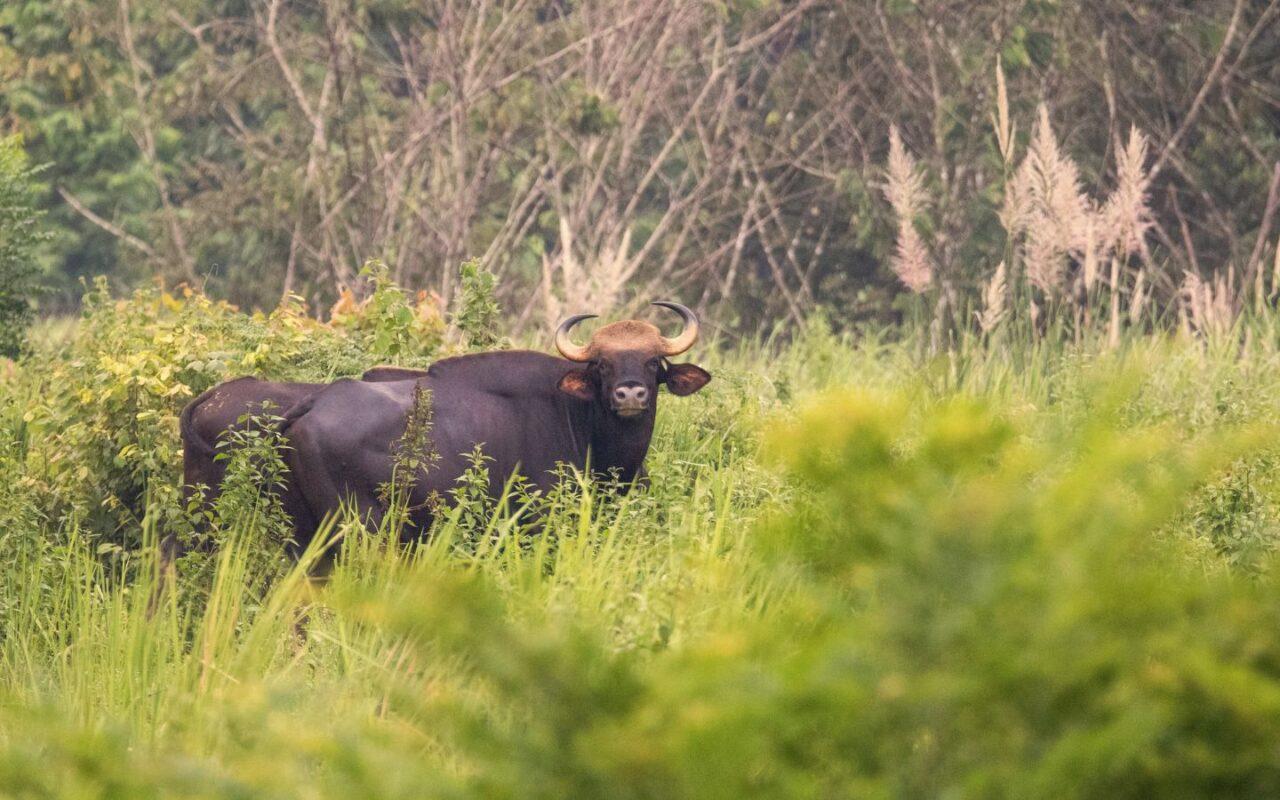
The Gaur, or Indian Bison, is the largest wild bovine in Southeast Asia and one of the most powerful mammals in Cat Tien. Massive yet surprisingly quiet, gaurs move between forest clearings, riverbanks, and grass-rich areas, grazing and browsing as they go.
Ecologically, gaurs play a key role in vegetation control. By feeding on grasses and shrubs, they prevent certain plant species from dominating, helping maintain plant diversity. Their movement patterns also influence nutrient cycling, as their dung enriches soil and supports insect communities.

![Itinerary - [14 Days] The Best Vietnam Wildlife Photography Tour](https://wanee.asia/wp-content/uploads/2025/03/Gaur-1442-1067x800.webp "Cat Tien’s Big Four: The 4 Most Important Large Mammals 6")
In Cat Tien, gaurs are mostly active in the early morning and late afternoon. Direct encounters are rare and should always be approached with caution and respect. More often, visitors notice flattened grass, hoof prints, or distant movement at forest edges.
The presence of gaurs signals a functioning forest floor—one that still supports large herbivores, predators, and complex plant dynamics.
C. Southern Yellow-cheeked Gibbon (Nomascus gabriellae): Voice of the Canopy
If elephants shape the ground and gaurs define the understory, gibbons belong to the sky. The Southern Yellow-cheeked Gibbon is perhaps the most emotionally powerful of Cat Tien’s Big Four—not because of its size, but because of its sound.
At dawn, gibbon family groups sing complex duets that echo across the forest canopy. These calls are not random. They define territory, strengthen pair bonds, and communicate forest occupancy across vast distances.
Gibbons are canopy specialists, moving almost exclusively through the treetops. Their presence indicates continuous forest cover and healthy canopy structure. When gibbons disappear, it often means the forest has become fragmented or degraded.


Cat Tien is one of the best places in Vietnam to experience gibbons in their natural habitat. Even without seeing them, hearing their morning calls offers a profound understanding of how alive the forest truly is.
D. Black-shanked Douc Langur (Pygathrix nigripes): Guardian of the Upper Forest
The Black-shanked Douc Langur is one of Vietnam’s most iconic and endangered primates. Endemic to the region, it relies on tall, mature forests with diverse tree species to survive.
Douc langurs are selective leaf-eaters, feeding on young leaves, flowers, and fruits that require specialized digestion. This makes them highly sensitive to habitat change. When forests are logged or simplified, doucs are often the first primates to disappear.
![Itinerary - A Black-shanked Douc is eating on the branch in [15-Day] Vietnam Primate Watching & Photography Tour.](https://wanee.asia/wp-content/uploads/2025/06/15-days-primate-watching-4-1067x800.jpg "Cat Tien’s Big Four: The 4 Most Important Large Mammals 10")

![Itinerary - [14 Days] The Best Vietnam Wildlife Photography Tour](https://wanee.asia/wp-content/uploads/2025/03/Black-shanked-Douc-4002-1066x800.webp "Cat Tien’s Big Four: The 4 Most Important Large Mammals 12")
In Cat Tien, doucs occupy the upper canopy, moving gracefully between trees in small, cautious groups. Their striking coloration is beautiful, but also a reminder of their vulnerability.
Protecting doucs means protecting forest complexity—large trees, continuous canopy, and long-term ecological stability. They are living indicators of how intact Cat Tien’s forest truly is.
Why These Four Matter More Than a Species List
Many visitors ask how many mammals they can expect to see in Cat Tien. The more important question is which mammals still survive here – and why.
The Big Four represent four essential ecological layers:
- Elephants shape the landscape
- Gaurs maintain forest-floor balance
- Gibbons connect the canopy through sound and movement
- Doucs preserve the integrity of upper forest ecology
Together, they form a living framework. Remove one, and the system weakens. Remove several, and the forest begins to unravel.
Seeing the Big Four: Expectations vs. Reality
Cat Tien is not a safari park. Wildlife encounters here are never guaranteed, and that is precisely what makes them meaningful. Observing signs, listening to calls, understanding habitats – these experiences are as valuable as direct sightings.
Responsible wildlife tourism in Cat Tien focuses on patience, respect, and learning. The goal is not to chase animals, but to understand their world.


A Shared Responsibility
Cat Tien National Park is more than a destination; it is a refuge for species that have lost much of their historical range. The Cat Tien Big Four represent the most influential large mammals of Cat Tien, shaping the forest from ground level to canopy through movement, feeding, and long-term ecological interactions. Their future depends on habitat protection, community cooperation, and thoughtful ecotourism.
To truly experience Cat Tien is to accept uncertainty – and to appreciate a forest that still breathes, sings, and moves through its largest inhabitants.
Responsible Wildlife Experiences with WANEE
Observing the Cat Tien Big Four – elephants, gaur, gibbons, and doucs – requires time, awareness, and respect for the forest. These large mammals of Cat Tien National Park are not easily seen, and their presence is often revealed through sounds, tracks, and subtle signs rather than direct encounters.
WANEE designs wildlife experiences that prioritize ecological understanding over sightings. By focusing on habitats, animal behavior, and conservation context, visitors gain a deeper appreciation of Cat Tien wildlife mammals and the fragile balance that sustains them.
Through responsible guiding and low-impact practices, WANEE supports conservation-minded travel in Cat Tien. Learn more about their nature-based programs here:
https://wanee.asia/cat-tien-tours/