

A Forest Structured by Geography, Not Altitude
To understand the ecological significance of the lowland tropical forest Cat Tien, one must first visualize southern Vietnam before large-scale agricultural conversion.
Historically, uninterrupted tracts of evergreen and semi-deciduous forest stretched from the southern Annamite Range (Truong Son Mountains) down to the wetlands of the Mekong Delta. These low-elevation plains were biologically productive and easily accessible – which also made them highly vulnerable.
Today, almost all comparable lowland forest has been replaced by rubber plantations, cashew farms, rice paddies, and expanding urban zones.
The Cat Tien National Park ecological value lies in one simple but profound fact: it represents the last large, contiguous reference sample of this ecosystem.
Located approximately 150 km north of Ho Chi Minh City and spanning roughly 71,000 – 82,000 hectares across Dong Nai, Lam Dong, and Binh Phuoc provinces, Cat Tien is not merely a protected area but a biogeographical bottleneck – a compressed transitional zone where upland and lowland systems converge.
This singular positioning contributed to its designation as a Cat Tien UNESCO Biosphere Reserve and its inclusion on the IUCN Green List Vietnam, recognizing governance quality and conservation effectiveness.


But recognition alone does not define its importance; its ecological mechanics do.
The Last Southern Lowland Reference System
Many Vietnamese national parks preserve montane forests – high-altitude systems that survived primarily because they were difficult to log or cultivate.
Cat Tien preserves something rarer: flat lowland forest.
Lowland forests are globally among the most endangered tropical ecosystems because they are accessible, fertile, and economically attractive; their disappearance erases baseline ecological reference conditions.
The lowland tropical forest Cat Tien therefore serves as:
- A genetic reservoir
- A hydrological buffer
- A biodiversity corridor
- A living baseline for ecological comparison
It is one of the few places in Vietnam where a riverine floodplain interacts directly with dipterocarp-dominated rainforest under natural monsoon cycles, producing ecological processes that cannot be observed in isolated upland parks.
The Three Physical Mechanisms That Make Cat Tien Unique
The uniqueness of the lowland tropical forest Cat Tien is not symbolic – it is structural.
Its resilience and diversity emerge from three physical mechanisms:
- Topographical Transition
- Hydrological Pulse
- Pedological (Soil) Mosaic
1️⃣ Topographical Gradient: Compression of Elevational Zones
The northern Cat Loc sector rises to approximately 659 meters, reflecting the foothills of the southern Annamites, while moving southward into Nam Cat Tien, elevation drops dramatically to around 115 meters.
This “step-down” gradient compresses altitudinal niches, allowing species typically separated by hundreds of vertical meters to coexist within a relatively compact horizontal space.

In field terms, this means:
- Highland floristic elements transition into lowland dipterocarp stands.
- Riverine wetlands exist within walking distance of semi-deciduous forest.
- Ecotones form rapidly, increasing edge complexity.
The result is not fragmentation but ecological layering.
2️⃣ Hydrological Pulse: The Dong Nai Reverse-Flow Effect
The Dong Nai River runs for roughly 90 kilometers along the park boundary and functions as both protective barrier and hydrological engine.
During peak wet-season flow, water levels rise significantly, forcing water backward through tributaries such as the Da Kluo stream; this reverse-flow mechanism expands the Bau Sau wetland complex from approximately 150 hectares in the dry season to over 2,500 hectares during monsoon peaks.


This is not incidental flooding – it is a nutrient pulse that redistributes sediment and organic matter into interior basins, supporting herbivore biomass and sustaining aquatic systems. The hydrological structure of Cat Tien mirrors, on a smaller scale, the flood-pulse dynamics of the Mekong–Tonle Sap system.
Without this annual expansion and contraction, the lowland tropical forest Cat Tien would lose its productivity engine.
3️⃣ Pedological Diversity: Soil as Structural Blueprint
Forest structure here is dictated by soil heterogeneity.
Deep alluvial sediment supports Evergreen Broadleaf Forest dominated by Dipterocarps such as Dipterocarpus alatus and Hopea odorata, forming cathedral-like canopy structures that require centuries to develop.
Shallower or basaltic soils support Semi-Deciduous Forest types including Lagerstroemia calyculata and Tetrameles nudiflora, which shed leaves during dry months to reduce water stress.
Disturbed or historically degraded soils support bamboo-dominated stands – evidence not of natural climax vegetation but of ecological recovery.


This patchwork prevents monoculture dominance and increases microhabitat variation.
What the Lowland System Feels Like
Ecological theory becomes tangible on the ground.
The Flat Jungle
Unlike northern mountainous parks, much of Nam Cat Tien is remarkably flat, with walking trails following ancient floodplain surfaces. This topography enables “grazing lawns” – grass-dominated openings maintained by flood cycles that provide visual access to large herbivores such as sambar deer and gaur.
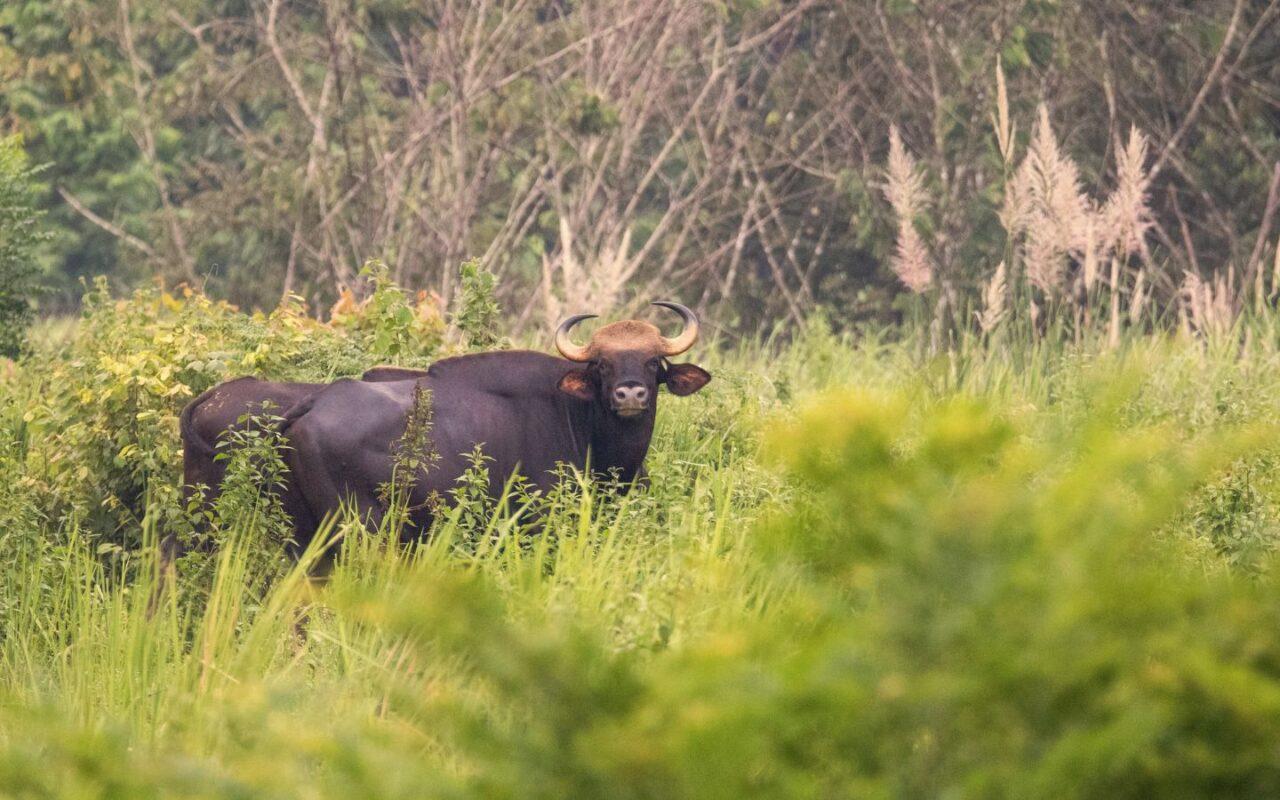


The flatness is not a lack of drama; it is the defining feature of lowland forest structure.
The Dominance of Giants
Massive buttress-rooted trees such as Afzelia xylocarpa and Tetrameles nudiflora dominate certain stands.

These are not plantation trees but structural markers of old-growth lowland forest, their scale reflecting uninterrupted growth cycles measured in centuries rather than decades.
The River Crossing Threshold
Entry into the park requires crossing the Dong Nai River by ferry, creating an immediate and visible ecological transition from agricultural buffer zones into protected forest.

Cashew farms end at the riverbank; primary forest begins on the opposite side.
Few protected areas in Vietnam demonstrate ecological isolation as clearly.
A Landscape of Loss and Recovery
It is essential to frame Cat Tien honestly. It is not untouched wilderness – it is a recovering ecosystem.
Large sections were defoliated during the Vietnam War, logging occurred in previous decades, and bamboo proliferation marks disturbance zones. Most significantly, the park failed to prevent the extinction of the Javan Rhinoceros in Vietnam – a sobering conservation lesson.

Yet recovery stories exist.
The Siamese Crocodile reintroduction Cat Tien program represents one of Southeast Asia’s rare successful freshwater crocodilian restorations, with individuals reintroduced into Bau Sau wetlands after local extinction.
The park’s governance improvements contributed to its recognition under the IUCN Green List Vietnam, reflecting measurable conservation performance rather than symbolic designation.


Recovery here is ecological, not cosmetic.
Island Dynamics and Conservation Pressure
The lowland tropical forest Cat Tien functions as an ecological island, surrounded by intensive agriculture and high human population density that limit species movement corridors.
Large mammals, including elephants, face compression pressures at park edges; human–wildlife conflict is not hypothetical but ongoing and structurally linked to landscape isolation.
This makes Cat Tien not only biologically important but politically fragile.
Its ecological value depends on:
- Buffer zone integrity
- Hydrological continuity
- Strict anti-poaching enforcement
- Landscape-scale planning
Climate, Comfort, and Misinterpretation
As a lowland tropical forest, Cat Tien is hot and humid year-round.
Dry-season months (November–April) may appear visually sparse in semi-deciduous sectors, with leaf drop resembling temperate autumn; this is adaptive phenology, not ecological decline.
Wet-season months (May–November) intensify insect activity, amphibian breeding, and canopy density.
Understanding the lowland tropical forest Cat Tien requires ecological literacy rather than visual assumptions.
Why Cat Tien Matters in a Regional Context
Southern Vietnam has lost the majority of its original lowland forest matrix. Without Cat Tien, ecological reference conditions would be theoretical rather than observable.
It provides:
- Baseline data for restoration science
- Hydrological modeling for floodplain systems
- Genetic refugia for lowland species
- A living laboratory for tropical forest recovery
Few protected areas simultaneously function as transitional corridor, floodplain forest, recovery site, biosphere reserve, and Green List benchmark.
Cat Tien does.
Limits and Ethical Framing
Conservation narratives must avoid romanticization.
Cat Tien is:
- Fragmented externally
- Recovering internally
- Vulnerable to climate variability
- Dependent on sustained management
Visitors must recognize that heat and humidity are structural rather than seasonal anomalies, wildlife sightings are probabilistic, and ethical conduct (no playback, no disturbance, no baiting) protects fragile recovery processes.


Visibility should never override ecological integrity.
Knowledge Network Expansion
Understanding the lowland tropical forest Cat Tien opens deeper inquiry into:
- Cat Tien: Rivers, Floodplains, and Seasonal Forest Dynamics: A deeper dive into the hydrological mechanism of the Bau Sau wetlands.
- Cat Tien’s Big Four: The 4 Most Important Large Mammals: Understanding the megafauna that this landscape supports.
- Discovering the Unique Flora: The Ancient Lagerstroemia Forest: Specifics on the semi-deciduous forest types mentioned above.
- The Conservation of Cat Tien NP: From Rhino to Rich Biodiversity: How this landscape failed to save the Rhino but succeeded for other species.
Together, these layers reveal a system structured by geography, water, and recovery — not scenery.
Conclusion: A Living Reference System
The lowland tropical forest Cat Tien is not merely a destination. It stands as the last large-scale ecological reference sample of southern Vietnam’s once-continuous floodplain rainforest, preserving structural processes that have disappeared elsewhere.
Within this landscape, topography compresses biodiversity across elevational gradients, hydrology drives seasonal productivity, and soil diversity shapes canopy composition. At the same time, increasing isolation intensifies conservation urgency, making the park both biologically significant and politically fragile.
In a region where most lowland forest has vanished, Cat Tien persists not as a pristine relic but as a resilient remnant. Its recovery story continues to unfold, and its value lies not in what it once was, but in what it continues to sustain.
For visitors seeking structured interpretation rather than surface-level exploration, field-based programs developed by WANEE integrate conservation ethics, wildlife literacy, and low-impact practice into the experience of the forest. These programs are designed not as entertainment excursions but as guided exposure to the living mechanics of a recovering lowland system. Further details about their Cat Tien field itineraries are available at:
https://wanee.asia/cat-tien-tours/