Cat Tien National Park: A Living Lowland Forest System
Tuan Kiet
February 15, 2026
Table of Contents
A Rare Intact System in a Fragmented Region
Cat Tien living in the lowland forest system is not an accident of isolation, but the result of a water-driven geography and an actively managed conservation model that together sustain one of Vietnam’s most resilient forest landscapes.
Cat Tien National Park (CTNP) sits within a region of Southeast Asia whose ecological integrity has been severely fractured by decades of rapid development, large-scale agriculture, and the long-term environmental consequences of historical conflict. Amidst this landscape, Cat Tien remains one of the most intact expressions of a lowland evergreen forest in Vietnam, functioning as a biological refuge within a fragmented region.
Within this altered landscape, Cat Tien National Park stands as one of the last significant lowland forest systems still functioning at landscape scale. Located approximately 150 kilometers north of Ho Chi Minh City, the park spans between 71,920 and 82,597 hectares across Dong Nai, Lam Dong, and Binh Phuoc provinces. It occupies a critical ecological transition zone where the southern reaches of the Truong Son (Annamite) Range descend into expansive lowland plains, creating structural conditions that support a resilient lowland evergreen forest in Vietnam.
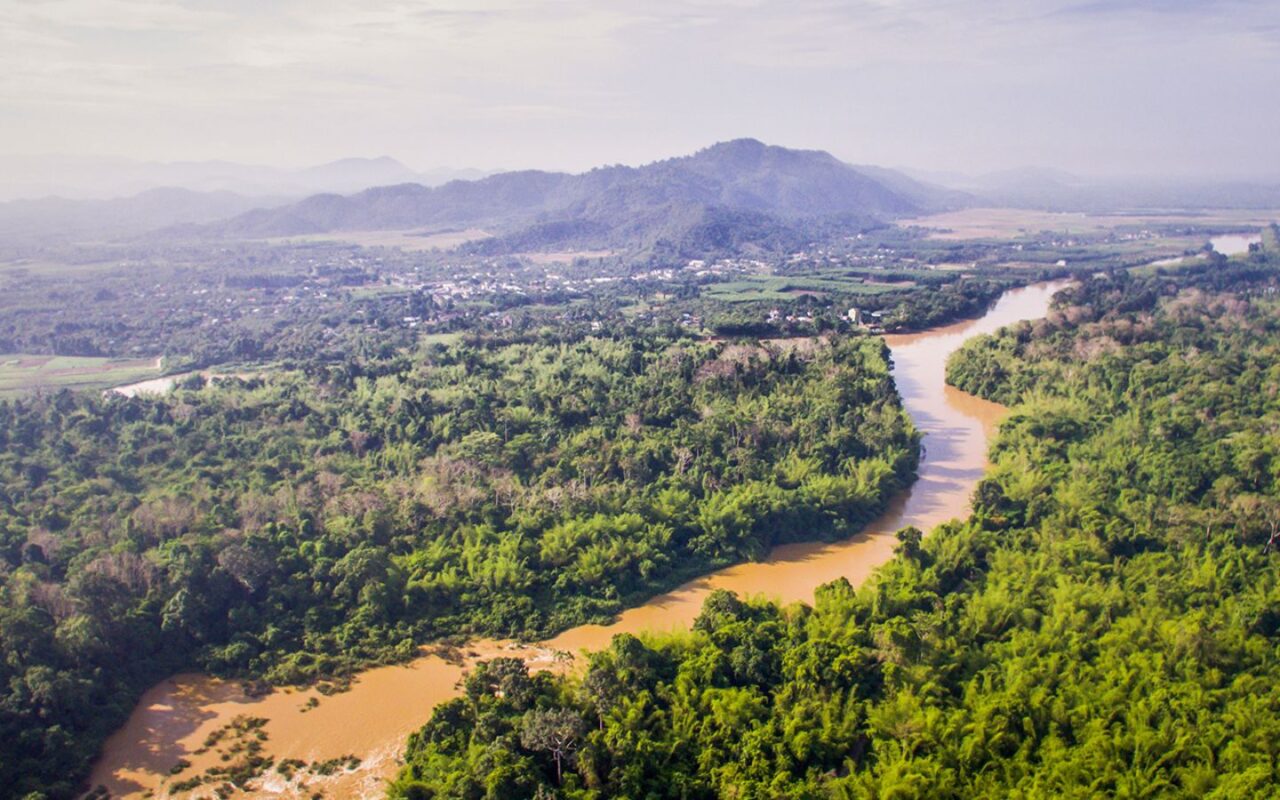
The breathtaking natural scenery of Cat Tien National Park. Source: Huynh Duong Bao
Cat Tien is not simply a protected patch of forest. Internationally recognized as part of the Dong Nai UNESCO Biosphere Reserve, designated as a Ramsar Site for its Bau Sau wetlands, and included in the IUCN Green List in 2024, it represents a rare case of active, measurable conservation. These recognitions reinforce the importance of Cat Tien living in the lowland forest system as a functioning landscape shaped by both natural hydrological structure and deliberate governance, rather than a passive wilderness preserved by isolation.
Resilience Through Geography and Governance in the Cat Tien Ecosystem Structure
Cat Tien’s ecological integrity does not survive because it is isolated from the modern world.
It survives because its water-driven geography creates structural resilience, and because a mature governance model actively reinforces that resilience against persistent human and climatic pressures.
The Dong Nai floodplain provides a hydrological backbone that stabilizes nutrient cycles and habitat dynamics. This physical foundation buffers the park from the regional pattern of lowland habitat collapse.
On top of this natural resilience operates an adaptive conservation framework – validated by IUCN Green List standards – that monitors, mitigates, and responds to threats.
It is the combination of biogeographic position, hydrological control, and institutional competence that allows Cat Tien to function as a living laboratory for species recovery rather than a fading forest fragment.
The Interacting Controls That Stabilize the System
1. Biogeographic and Topographical Control
Cat Tien sits at a rare ecological intersection.
The northern Cat Loc sector rises into foothill terrain reaching elevations above 600 meters, while the southern Nam Cat Tien sector drops below 130 meters, forming broad lowland plains and seasonal wetlands.
This step-down gradient compresses multiple habitat types into one contiguous protected area:
Highland-influenced slopes
True lowland evergreen forests
Semi-deciduous forest patches
Floodplain wetlands
Variation in soil depth, rock exposure, and slope determines forest distribution. Deep soils support towering evergreen stands dominated by Dipterocarpaceae such as Dipterocarpus alatus. Shallower or rockier ground favors semi-deciduous species like Lagerstroemia calyculata.
Cat Tien National Park within Dong Nai Biosphere Reserve
This topographical mosaic increases habitat diversity and provides micro-movement corridors for wildlife adapting to seasonal shifts.
2. The Hydrological Spine: The Dong Nai Floodplain
The Dong Nai River flows along the park boundary for nearly 90 kilometers.
It functions both as a natural defensive boundary and as the lifeblood of the ecosystem. The seasonal dynamics of the Dong Nai floodplain forest do more than supply water; they regulate nutrient cycling, sediment transport, and forest regeneration patterns that define the broader Cat Tien ecosystem structure.
During the rainy season, rising water levels inundate internal basins, most notably Bau Sau (Crocodile Lake). Wetland area can expand to several thousand hectares, forming interconnected ponds and swamp systems.
This seasonal flood pulse:
Transports nutrient-rich sediment
Supports aquatic and semi-aquatic food webs
Creates nurseries for fish and amphibians
Provides feeding grounds for resident and migratory waterbirds
The Dong Nai River system forms a natural boundary that encloses Cat Tien’s forested landscape.
Without this hydrological rhythm, the forest would lose productivity and structural diversity. The floodplain dynamic is what prevents stagnation.
This hydrological pulse is not incidental; it is foundational to Cat Tien living in the lowland forest system. Without the seasonal expansion of the Dong Nai floodplain forest, nutrient redistribution and regeneration cycles would weaken, and the Cat Tien ecosystem structure would gradually fragment into simplified forest blocks.
3. Ecosystem Typology and Adaptation
The interaction of terrain and flooding sustains over 1,600 recorded plant species across multiple forest types:
Primary Evergreen Broad-Leaved Forests
Semi-Deciduous Forests
Mixed Wood and Bamboo Forests
Bamboo-dominated zones often reflect historical disturbance, including wartime defoliation. They represent secondary succession rather than pristine balance.
Together, these forest types form a layered ecological architecture that explains how Cat Tien living in the lowland forest system differs from montane or coastal forest systems elsewhere in Vietnam.
Key forest types that define Cat Tien National Park.
This structural heterogeneity maintains ecological niches for primates, mesomammals, ground-dwelling birds, and reptiles.
What makes Cat Tien living in the lowland forest system ecologically rare is not species richness alone, but the way these forest types interact across soil gradients and seasonal flooding patterns. This layered arrangement defines the Cat Tien ecosystem structure and explains why it remains one of the last functioning examples of lowland evergreen forest Vietnam at landscape scale.
Cat Tien is not one forest type. It is a functioning mosaic.
4. Governance as an Ecological Mechanism
Physical resilience alone is not enough.
Cat Tien’s 2024 inclusion on the IUCN Green List reflects a management model that treats governance as ecological infrastructure.
Cat Tien National Park received the IUCN Green List designation on June 21, 2024 (officially recognized on April 19, 2024). Source: Huynh Duong Bao
Key mechanisms include:
SMART-based patrol systems
AI-enabled camera monitoring
Thermal drones tracking Asian elephant movement
Community Forest Ranger programs
Revenue-sharing and livelihood integration for local communities
This is not symbolic protection, but active mitigation in which threats are continuously monitored and addressed. The persistence of Cat Tien living in the lowland forest system can therefore be understood as a feedback loop: seasonal flooding regulates soil fertility, soil fertility shapes vegetation structure, vegetation structure supports fauna, and fauna interactions reinforce regeneration patterns — all sustained within a governance framework that buffers external disruption.
What a Living Lowland Forest Feels Like
Walking into Nam Cat Tien, you immediately feel the flatness of ancient floodplain terrain beneath your boots. You are not climbing ridges – you are moving across sediment shaped by centuries of river flow.
In the wet season, the forest is saturated green. In the dry season, semi-deciduous patches shift to gold and rust tones as trees conserve water.
Massive buttress roots of Tetrameles nudiflora anchor the landscape like structural pillars. Some individuals exceed four centuries in age. They are living archives of ecological continuity.
But Cat Tien is not untouched wilderness.
The Vietnamese Javan rhinoceros was declared extinct here in 2010. The Indochinese tiger is functionally extinct.
The persistence of Gaur, a small isolated herd of Asian elephants, and the Southern yellow-cheeked gibbon reflects survival under pressure, not abundance without limits.
At Bau Sau, the reintroduction of Siamese crocodiles between 2000 and 2005 rebuilt a self-sustaining population now estimated at over 300 individuals. This is measurable recovery – proof that management intervention can restore keystone roles.
GaurVietnamese Javan RhinocerosSiamese Crocodile
The forest tells a story of resilience, not perfection.
Limits, Non-Fit & Ethics
❌ Ongoing Vulnerabilities
Cat Tien operates under constant pressure:
Wire snaring driving “empty forest” syndrome
War legacy zones converted to bamboo
Habitat fragmentation around buffer zones
Human-wildlife conflict, especially involving elephants
The park functions as an ecological island surrounded by agricultural landscapes.
Resilience does not mean invulnerability.
✔️ Ethical Engagement
To engage with Cat Tien responsibly means:
Accepting that sightings of megafauna are not guaranteed
Understanding that recovery, not spectacle, defines its story
Respecting its status as a protected scientific and conservation landscape
Avoiding any behavior that fuels wildlife trade or extractive pressure
Respecting the Ma and Stieng communities whose participation underpins governance
Cat Tien survives through active defense. Ethical visitors become part of that defense.
Why Cat Tien Still Matters
Cat Tien is not important because it is scenic. It matters because it still functions. In a region where lowland evergreen forest in Vietnam has largely disappeared, Cat Tien remains a living lowland forest system—stabilized by the seasonal rhythms of the Dong Nai floodplain, structured by soil and elevation gradients, and reinforced by active governance. Its resilience is not the result of isolation from modern pressures, but of a deliberate interaction between geography and conservation management.
For those who wish to experience this lowland forest system with ecological depth rather than surface tourism, WANEE offers guided wildlife journeys designed around conservation literacy and field-based interpretation. Explore our Cat Tien programs here: 👉 https://wanee.asia/cat-tien-tours/
To deepen your understanding of the ecological mechanisms that sustain Cat Tien National Park, consider exploring the following related Knowledge Assets:
Tell us what you hope to see, photograph or experience. We will suggest a realistic route or tell you honestly if another season or destination fits better.




![Itinerary - [14 Days] The Best Vietnam Wildlife Photography Tour](https://wanee.asia/wp-content/uploads/2025/03/Gaur-1442-1067x800.webp "Cat Tien National Park: A Living Lowland Forest System 8")

