

Into the Forest Before Sunrise
At around 05:45, while most of Cat Tien is still quiet, we begin moving into the forest. The darkness is only starting to lift, and there is little to see beneath the canopy. Insects and birds are gradually becoming more active, but we keep our voices low and our movements slow. For a morning of gibbon watching, there is no reason to hurry. The important thing is simply to be in the forest when it begins to wake.
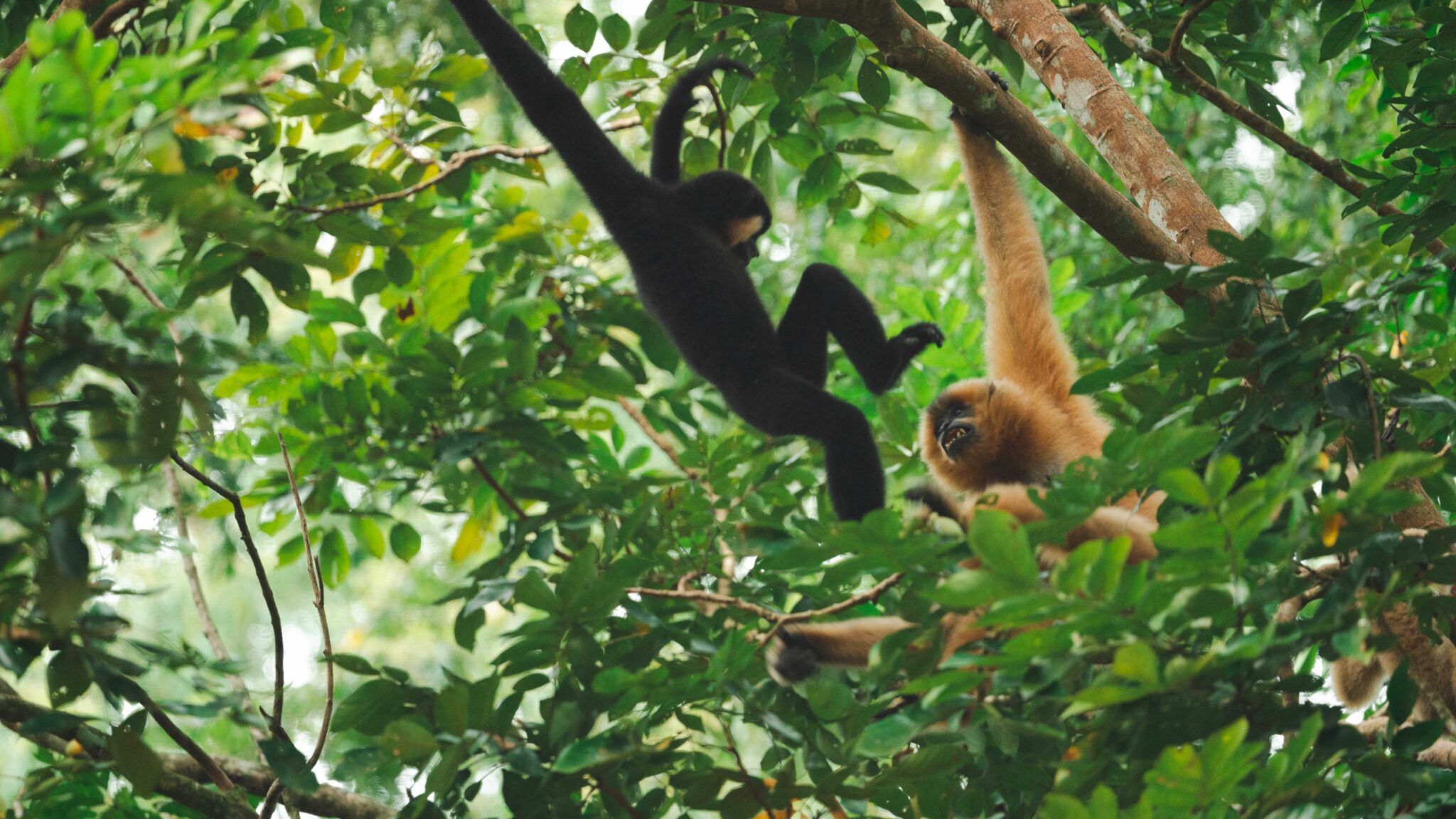
On a clear morning, the first sunlight reaching the upper canopy can coincide with the beginning of the territorial calls of the Southern Yellow-cheeked Gibbon (Nomascus gabriellae). But long before we see one, we usually hear one.

(Nomascus gabriellae)
The first call can seem to come from somewhere far beyond us. We stop and listen, trying to understand its direction and distance. Gibbons spend almost their entire lives in the canopy, so sound often gives us information that our eyes cannot. A guide may know the broader territory used by a family, but there is no particular tree where the animals are guaranteed to appear that morning. The calls tell us where to start looking, but the forest decides what happens next.
Following a Voice Through the Canopy
Sometimes we stay where we are. Sometimes, after listening carefully, we make a quiet change of position. Foliage, terrain and the animals’ movement through the canopy can make the difference between a brief glimpse and nothing more than a voice passing through the trees.

That uncertainty becomes particularly noticeable when we move deeper into the forest. Here, the calls feel more distant and the surrounding forest quieter. A family may be somewhere across the canopy, but even with a guide familiar with the area, there is no guarantee that we will see them. A morning can bring a fleeting glimpse between leaves, a family crossing a canopy gap, or simply a series of calls that we never manage to trace to a clear view.
Near the primate rehabilitation area, the experience can be different. One established family originated through a reintroduction process and continues to use the surrounding forest, making encounters generally more reliable. The forest structure may also give us clearer opportunities to see them.

At the same time, calls from free-ranging gibbons can overlap with vocalisations from animals still being cared for within the rehabilitation facility. For us, this is an important distinction: seeing a gibbon there can be a meaningful encounter, but it is not the same experience as locating a fully wild family deeper in the forest.
When the Weather Changes the Morning
As the morning develops, the weather begins to matter just as much as our listening.
A planned 05:45–06:00 start does not always lead to immediate activity. During wet conditions, gibbons may remain sheltered and silent. Even after rain has stopped, the forest can stay dark, delaying the beginning of their morning calls. On brighter days, the first sunlight entering the canopy can coincide with the start of their territorial songs.
This is why we never treat the timing as a fixed promise. We arrive early, but then we wait for the forest to tell us when the morning has really begun.
Our guides also keep recent weather conditions in mind when deciding how to approach the morning. The seasonal information in the WANEE seasonal wildlife guide helps us understand how rainfall and changing conditions may affect activity in the canopy.
The Moment We Did Not Expect
The longer we stay in the forest, the more natural it becomes to think of the encounter through sound rather than sight. We do not use playback to provoke a response. If a family begins travelling rapidly through the canopy, particularly if its movement suggests alarm or discomfort, we stop following. There is little value in turning a possible sighting into a pursuit.
And sometimes, when we stop looking for the perfect view, something much more meaningful happens.
During one encounter, we watched a young gibbon being handled too forcefully by an adult male. Almost immediately, the mother intervened. She positioned herself between the male and the youngster and prevented him from touching the young gibbon again.
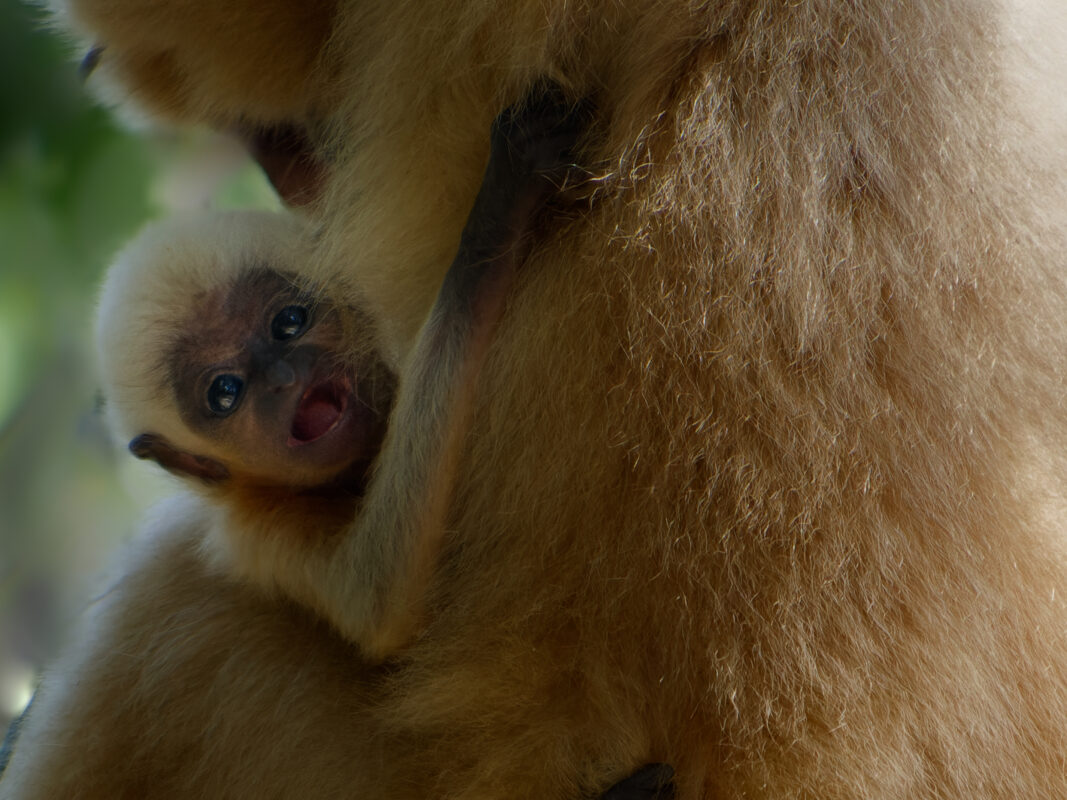
Nothing about the moment had been planned, and there was nothing we could have done to create it. We only had to remain quiet enough for it to happen naturally in front of us. This is often what makes a field morning memorable. The most valuable observation is not necessarily the clearest photograph or the longest view. It can be a few seconds of behaviour that would have been impossible to predict from an itinerary.
This is one reason patient observation matters. The most valuable experience may not be a close photograph, but a short piece of natural behaviour that becomes visible only when the group remains quiet and gives the animals space. These kinds of social dynamics are beautifully documented in our Cat Tien National Park Wildlife Guide
, which describes much of the primate and mammal behaviour we frequently encounter. For photographers seeking truly ethical opportunities to capture this wildlife, our Vietnam wildlife photography tour emphasizes natural light, respectful distances, and realistic field expectations without ever applying pressure on the animals.
When Hearing Is Enough
By the time the morning begins to settle, we may have seen the animals clearly, caught only a glimpse between leaves, or heard them calling from somewhere we could never reach safely. Sometimes the forest remains quiet altogether because the weather has changed their routine. None of these outcomes necessarily feels like a failure.
Standing beneath the canopy while a wild gibbon family calls somewhere beyond sight gives us a sense of how large the forest really is. The sound travels farther than our eyes can follow, carrying through a landscape that does not operate according to our schedule.
A hearing-only encounter can therefore remain with us just as strongly as a clear visual sighting. The sound itself becomes evidence that somewhere beyond the trees, a family is moving through and communicating within a much larger forest than the small section we can see.
Letting the Forest Decide
As we eventually make our way out of the forest, what stays with us is not always the clearest sighting.
It may be the first call arriving through the darkness, the long wait beneath a quiet canopy, a fleeting movement between leaves, or that unexpected moment when a mother moved between her young and the adult male. We arrive before the forest is fully awake. We listen. We wait. We move when there is a reason to move, and we stop when the animals tell us that we should. Sometimes they give us a clear view; sometimes they give us only a voice.



Either way, the encounter belongs to the forest, not to our itinerary. And that is what makes watching wild gibbons in Cat Tien so special. If you are interested in how we translate this into wider conservation efforts, our Responsible Wildlife Tourism framework explains exactly why we operate this way.
Practical takeaways
- Plan to begin around first light, usually approximately 05:45–06:00, depending on weather and season.
- Clear mornings are generally more favourable than rainy ones.
- Staying inside the park is the most practical arrangement for pre-dawn access.
- Encounters near the rehabilitation area are usually more reliable, but differ from locating wild families deeper in the forest.
- Hearing gibbons without seeing them is still a meaningful natural-history encounter.
- Playback is not used to trigger calls.
- Guides should stop following when the animals’ movement suggests alarm or discomfort.
- Silence, suitable clothing and realistic expectations matter more than specialised equipment.
Continue exploring
Experience Cat Tien at First Light
Tell us about your travel dates, wildlife interests, preferred pace and photography priorities. We will recommend a realistic Cat Tien plan based on current access, weather and field conditions.
➔ Plan a Cat Tien Wildlife Journey
