

The Red-shanked Douc is one of Vietnam’s most iconic primates and one of the strongest wildlife reasons to visit Central Vietnam. If you are wondering where to see Red-shanked Douc in Vietnam, the best-known and most accessible destination is the Son Tra Peninsula near Da Nang, where coastal evergreen forest still supports an important population. For travelers seeking a dedicated journey to this species, a responsible Vietnam primate watching tour provides the ideal foundation for this experience.

Other Central Vietnam forests may form part of a broader Vietnam primate watching journey, but many sites are conservation-sensitive and should not be promoted with exact access details.
A responsible Red-shanked Douc experience is not about getting as close as possible. It is about maintaining distance, moving calmly, avoiding feeding or crowding, respecting local regulations, and understanding the forest that allows these animals to survive. For photographers, realistic expectations about distance, canopy cover, light, and behavior are essential. A responsible operator should never promise close photographs or guaranteed troop encounters.
Why the Red-shanked Douc Matters
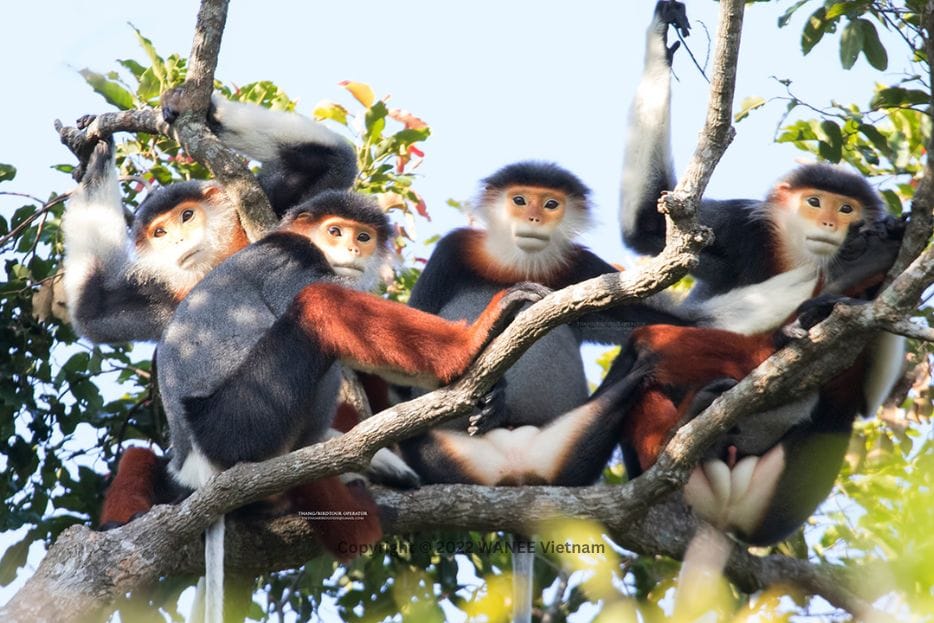
The Red-shanked Douc (Pygathrix nemaeus) is one of the most visually striking primates in Southeast Asia. Its colorful appearance, long white tail, and expressive face make it highly attractive to wildlife travelers and photographers.

©: Tuan Ba Gau
Its beauty, however, can also create pressure. Visitors may seek closer photographs, and some operators may be tempted to market a sensitive primate as a guaranteed attraction.
For WANEE, the Red-shanked Douc should be presented as a conservation-sensitive wildlife highlight rather than a display animal. The key message is simple: Vietnam offers rare opportunities to observe this remarkable species, but only when the experience is built around respect, distance, and conservation awareness.
What Makes Red-shanked Doucs Different from Other Primates?
Red-shanked Doucs are arboreal, canopy-dwelling colobine monkeys associated with evergreen forests and complex forest structure. Their diet consists largely of young leaves, buds, flowers, fruits, and seeds, and their movements are closely linked to habitat quality and food availability.
For travelers, this means a Red-shanked Douc encounter is also a forest experience. Observing feeding behavior, canopy movement, social interactions, and habitat use often provides more value than simply adding another species to a checklist.
| 💡Theme | ✨What It Means for Travelers | ✅Responsible Interpretation |
|---|---|---|
| Appearance | Highly colorful and photogenic. | Do not let beauty create pressure for intrusive photographs. |
| Habitat | Usually observed in forest canopy. | Interpret the forest, not just the animal. |
| Behavior | May feed, groom, rest, move, or remain hidden. | Allow natural behavior without interference. |
| Photography | Distance, canopy, and light strongly affect results. | Ethical boundaries are more important than image quality. |
| Conservation | A flagship species for Central Vietnam conservation. | Use sightings to promote habitat protection. |
Where to See Red-shanked Douc in Vietnam?
The most accurate public answer is that Red-shanked Doucs are strongly associated with Central Vietnam, particularly Son Tra near Da Nang, along with selected forest landscapes across the region.
This article deliberately avoids becoming a micro-location guide. Exact troop locations, feeding trees, GPS points, roosts, or daily movement patterns should never be publicly shared.
| 📍Region / Site | 🌳Role for Viewing | 👍Best For | ‼️Sensitivity Note |
|---|---|---|---|
| Son Tra Peninsula | Best-known and most accessible viewing context. | Travelers seeking a short primate experience. | High visitor pressure requires careful behavior. |
| Central Vietnam Forest Route | Broader wildlife and primate route context. | Specialist wildlife travelers. | Avoid exact access information. |
| Bach Ma Context | Part of the wider biodiversity story. | Longer wildlife journeys. | Treat primarily as conservation context. |
| Phong Nha Context | Supports broader primate conservation interpretation. | Specialist wildlife routes. | Highly sensitive. |
| Rescue and Education Contexts | Conservation learning opportunities. | Families and educational travelers. | Should never be confused with wild viewing. |
Son Tra: The Key Red-shanked Douc Destination
Son Tra remains the best-known destination for Red-shanked Douc watching in Vietnam and a common starting point for a Central Vietnam wildlife tour.
Son Tra Peninsula is the most important public destination when discussing where to see Red-shanked Douc in Vietnam. Its combination of accessibility, evergreen forest, and strong association with the species makes it a flagship destination for responsible primate watching.


Its accessibility is also its greatest challenge. Tourism traffic, roadside viewing pressure, photography demand, and development concerns can affect both wildlife welfare and visitor experience.
Public content should frame Son Tra as a conservation-sensitive coastal forest rather than a casual roadside wildlife attraction.
A visitor may encounter doucs here, but every observation should be guided by distance, patience, and respect for the forest.
Why Son Tra Should Not Be Treated as a Guaranteed Photo Stop
Because Son Tra is accessible, some travelers assume Red-shanked Douc viewing is easy.
That expectation is misleading.
Visibility depends on weather, traffic, troop movement, feeding activity, disturbance levels, and forest conditions. Animals may appear briefly, remain distant, or disappear into dense canopy.
The right promise is not:
“We will get you close to Red-shanked Doucs.”
The right promise is:
“We will help you look for them responsibly, understand their behavior, and experience the forest in a way that respects wildlife.”
Central Vietnam: A Broader Primate Route
A meaningful Central Vietnam wildlife tour should place Son Tra within a larger conservation landscape.
The region contains coastal forests, humid mountains, protected areas, limestone ecosystems, and important primate habitats. Together they support some of the most rewarding Vietnam primate watching opportunities in the country. For travelers interested in the full ecological spectrum, these limestone karst areas also support highly diverse reptile and amphibian life, making them ideal for herping expeditions in Vietnam as well.
Rather than treating Central Vietnam as a checklist of primate sites, travelers should view it as a connected conservation landscape where primates, birds, forests, and local conservation efforts form part of a larger ecological story. A well-planned birding route in Vietnam can easily integrate these primate sites into a broader avian and forest exploration.
| ✨Traveler Goal | 👍Best Route Logic | 🤔Expectation |
|---|---|---|
| See Red-shanked Douc near Da Nang | Begin with Son Tra. | Possible but never guaranteed. |
| Strong primate photography | Combine Son Tra with specialist wildlife routes. | Depends on light, distance, and ethics. |
| Birds, primates, and ecology | Build a broader Central Vietnam wildlife route. | Best approached as a multi-habitat journey. |
| Conservation learning | Include interpretation and education opportunities. | Focus on habitat and protection. |
| Guaranteed close encounters | Not a realistic expectation. | Responsible operators should not promise this. |
Responsible Red-shanked Douc Watching Rules
Responsible viewing should always come first.
- Keep a respectful distance.
- Use binoculars or long lenses instead of approaching.
- Never feed wildlife.
- Do not chase or crowd groups.
- Avoid loud noise and disturbance.
- Do not use drones near wildlife unless explicitly permitted.
- Do not share exact troop locations online.
- Respect local regulations and conservation guidance.
- Accept that distant natural observations are better than intrusive close encounters.
Photography Expectations: Beautiful Species, Difficult Conditions
Red-shanked Douc photography in Vietnam can be highly rewarding, but it also requires realistic expectations. For those specializing in this craft, our wildlife photography tours in Vietnam are intentionally paced around the best morning and evening light.
Photographers should prepare for:
- Distance;
- Canopy cover;
- Variable light;
- Backlighting;
- Branch obstructions;
- Partial views;
- Animal movement.
A good photograph should never come at the expense of animal welfare.
| 📸Photo Factor | ✨Field Reality | 💡WANEE Expectation |
|---|---|---|
| Distance | Animals may remain high in the canopy. | Long lenses are preferred over close approaches. |
| Light | Shade and backlight are common. | Good photos depend on conditions, not just sightings. |
| Behavior | Animals may feed, move, or disappear. | Natural behavior comes first. |
| Visitor Pressure | Other visitors may be present. | Patience and discipline matter. |
| Ethics | Close photos can create pressure. | No image is worth stressing wildlife. |
Red-shanked Douc photography in Vietnam requires patience, ethical field behavior, and realistic expectations about distance and light conditions.
Best Time and Field Rhythm
There is no guaranteed best time to see Red-shanked Doucs. To align your trip with the most productive weather windows, we recommend consulting our seasonal wildlife guide before finalizing dates.
Early mornings and late afternoons often provide better viewing conditions and softer light, while midday can be hotter, brighter, and busier.

| ⏱️Time / Condition | 👀Viewing Implication | 📝Planning Note |
|---|---|---|
| Early Morning | Often calmer with better light. | Excellent for responsible observation. |
| Late Afternoon | Softer light and potential activity. | Depends on local conditions. |
| Midday | Harsh light and potentially more visitors. | Better for rest or interpretation. |
| Rain or Fog | Reduced visibility. | Build flexibility into plans. |
| High Visitor Pressure | Lower observation quality. | Move slowly and avoid crowding. |
How Many Days Do You Need?
A Red-shanked Douc experience can be a short wildlife extension from Da Nang, but it becomes far more meaningful when incorporated into a broader wildlife route.
| 📅Trip Length | 👍Best For | ✨What It Can Realistically Do |
|---|---|---|
| Half Day / 1 Day | Travelers already in Da Nang. | Responsible viewing attempt and interpretation. |
| 2–3 Days | Nature extensions. | Adds flexibility and broader context. |
| 4–6 Days | Wildlife, birding, and primates. | Better pacing and conservation interpretation. |
| 7–12 Days | Specialist wildlife travelers. | Broader Central Vietnam route. |
| Tailor-Made | Photographers and conservation-focused guests. | Designed around specific goals. |
WANEE does not present Red-shanked Doucs as a guaranteed attraction.
Instead, this experience is positioned as a conservation-sensitive primate encounter where wildlife welfare, habitat protection, and responsible observation come first.
The goal is to help travelers understand not only where to see Red-shanked Doucs, but also why their survival depends on healthy forests and responsible tourism.
Common Mistakes When Planning Red-shanked Douc Viewing
- Treating Son Tra as a guaranteed wildlife stop.
- Prioritizing close photographs over welfare.
- Sharing exact locations online.
- Assuming easy access means low sensitivity.
- Ignoring habitat and conservation context.
- Choosing operators without clear ethical standards.
Suggested Go-WILD Journey Types
Son Tra Responsible Douc Watching
Best for travelers seeking a short but meaningful primate experience near Da Nang.
Central Vietnam Primate and Wildlife Route
Best for travelers combining primates, birding, and conservation-focused wildlife experiences.
Primate Photography Journey
Best for photographers interested in ethical wildlife photography and realistic field conditions.
Wild Harmony – Coastal Forest and Conservation
Best for travelers seeking slower nature experiences centered on ecology, conservation, and interpretation. Our Wild Harmony excursions offer a unique blend of conservation storytelling and a gentler field pace.
Planning to See Red-shanked Douc in Vietnam?
Tell us your travel dates, photography goals, comfort preferences, and available time.


WANEE can help design a responsible Central Vietnam wildlife tour that combines Red-shanked Douc watching in Vietnam, wildlife photography opportunities, conservation interpretation, and realistic field expectations.
Join the WANEE Team to explore Vietnam’s wildlife responsibly, ethically, and meaningfully.
FAQ
Where can I see Red-shanked Douc in Vietnam?
Son Tra Peninsula near Da Nang is the best-known and most accessible destination. Other Central Vietnam forests may be relevant for broader wildlife routes, but sensitive locations should not be publicly shared.
Is Son Tra the best place to see Red-shanked Douc?
Yes. Son Tra is widely regarded as the strongest public-facing destination for responsible Red-shanked Douc viewing.
Are sightings guaranteed?
No. Red-shanked Doucs are wild primates, and sightings should never be guaranteed.
Can I photograph Red-shanked Doucs in Vietnam?
Yes. Red-shanked Douc photography in Vietnam is possible, but distance, canopy cover, light conditions, and ethics all influence results.
Is it ethical to watch Red-shanked Doucs?
Yes, when done responsibly through respectful distance, minimal disturbance, and adherence to local conservation regulations.
Should I combine Red-shanked Doucs with birding?
Absolutely. A broader Central Vietnam wildlife tour can combine primates, birding, forests, and conservation interpretation into a richer wildlife experience.
Related Reading
If this ethical approach to primate travel resonates with you, our field team has compiled the following guides to help you refine your travel choices and expectations:
- Primates of Vietnam: Where to See Them Responsibly – A comprehensive field guide for spotting gibbons, doucs, langurs, and lorises across the country.
- How to Choose a Wildlife Tour in Vietnam – Practical criteria to help you distinguish authentic, low-impact operators from commercial mass tours.
- Responsible Wildlife Tourism in Vietnam – Our core principles on conservation, animal welfare, and ethical field behaviors.