


Southern Vietnam lies along the East Asian–Australasian Flyway, making Mekong shorebirding an essential experience for birdwatchers tracking migratory species across coastal and inland wetlands. Success here is rarely about simply arriving at a site at the right hour. It means reading the tide, the exposed mud, the movement of birds, human activity, and the conditions that determine how—and how closely—we can observe.
At around 9:00 in the morning, the tide at Go Cong had receded far enough to open the mudflat. The wetland slowly revealed the feeding ground, and with it came the reason we had timed our morning around the tide. We were not simply looking for birds. We were watching the landscape change first—mud appearing, flocks gathering, and distant movement becoming easier to follow as the water pulled back.


This is what makes wetland birding in the Mekong so rewarding. From the coastal mudflats of Go Cong to the flooded grasslands and open marshes of Tram Chim, the habitats may look very different, but each asks us to pay attention to the conditions before deciding how to observe.
A Morning with the Tide at Go Cong
At Go Cong, the exposed mudflat was the starting point. Lower tidal conditions can be more practical because they reveal feeding habitat, but low tide does not automatically mean birds will be close. The important question is where the birds will settle once the feeding ground becomes available. That morning, we stood scanning the wide expanse of mud, following movement within the flock and checking one bird after another. Most movements disappeared as quickly as they appeared.
We found a Spoon-billed Sandpiper (Calidris pygmaea). For a moment, the search narrowed from the entire mudflat to one small bird among many. It was exactly the kind of encounter that reminds us why patience matters on a tidal flat. The species is a rare but possible target during the appropriate migratory season, rather than a predictable sighting. Finding one can depend on suitable tidal conditions, recent field information, access to the right section of mudflat, prolonged scope scanning—and considerable luck.

We continued scanning rather than allowing the sighting to become the entire morning. Around the Spoon-billed Sandpiper were other migratory shorebirds: Great Knots, Nordmann’s Greenshanks, Terek Sandpipers, curlews, sand-plovers, and other waders can use the same habitat. The flock itself became part of the experience, with birds moving, feeding, and shifting position as the mudflat changed around them. Through binoculars, we could follow the wider movement of the flock, while the spotting scope allowed us to look more closely when identification became difficult. Bill shape, head pattern, leg color, plumage, body proportions, feeding behavior, and association with other species can all help separate similar-looking waders, although distance, wind, heat distortion, and constant flock movement can still make a definitive identification difficult.

©: Sam Thuong
So we stayed with the flock.
The Mudflat Is a Working Landscape
Birding at Go Cong also means sharing the mudflat with the people who work there. The surface is soft, sticky, uneven, and physically demanding, so moving across it requires us to consider mud depth, tidal timing, safe return windows, firmer footing, weather conditions, the group’s physical ability, and active clam-farming zones. Newly stocked clam areas may contain young shellfish that can be damaged by foot traffic. Responsible access therefore means recognizing active farming zones, following acceptable routes, and going around working areas when necessary.
A rare bird never justifies damaging someone’s livelihood. The same principle applies to the birds. If a flock can already be observed adequately from a safe position, there is little reason to keep moving closer simply for a better view. In shorebirding, position and patience often matter more than proximity, and sometimes staying where we are gives us a better encounter than trying to move closer.

As the morning progressed, we had already seen what we had come for. More importantly, we had spent time watching how the wetland itself shaped the encounter. The tide had determined when the feeding ground appeared, the flock had determined where our attention settled, and the conditions had determined how we could observe. Then it was time to leave the mudflat and continue toward another kind of Mekong wetland.
By Three in the Afternoon, the Landscape Changes Again
After leaving the coastal wetlands behind, we continued toward Tram Chim National Park. By the time the afternoon heat began to ease, we arrived at the hotel, where our boat was waiting to take us into the wetland. Around 15:00, we stepped aboard and began our journey. After the exposed mudflat of Go Cong that morning, the change was immediate. The weather was gentler, the air felt cooler, and there was something particularly enjoyable about moving slowly across the water, watching the landscape unfold around us while keeping our eyes open for birds.
The flooded grasslands, canals, and open marshes of Tram Chim created a different setting for observation, one that offered plenty of opportunities to look for wetland and waterbirds. There was no need to walk across soft mud or constantly reposition ourselves on foot. Instead, the boat carried us deeper into the landscape, and the search became part of the journey itself. We moved along the water, sometimes watching quietly, sometimes scanning the vegetation and open areas ahead, with the excitement of not knowing what might appear next.

Then the small moments began to stand out. A Pied Kingfisher became one of them. Every few minutes, it would beat its wings and plunge toward the water, repeating the same hunting sequence as we watched. There was something captivating about the rhythm: wings beating, a sudden dive, then the wait for the next attempt. We did not need to move closer. The behavior itself kept drawing our attention back.
Not far away, a Little Cormorant offered a completely different scene. After what appeared to have been another pursuit of fish, it spread its wings beneath the afternoon sun, holding them open as it dried and warmed its body. One bird was all movement; the other was almost perfectly still. From the boat, these simple behaviors became the moments that made the journey memorable—not because they were dramatic, but because we had the time and space to watch them unfold. The hum of the long-tail boat engine slowed to a gentle purr. Around us, the scent of fresh lotus leaves filled the air, intermingled with the soft rustle of Melaleuca trees lining the water’s edge. Unlike the open, sun-baked mudflats of Go Cong, Tram Chim offered an immersive sensory experience—where the calls of hidden wetland species echoed gently through the reed beds.

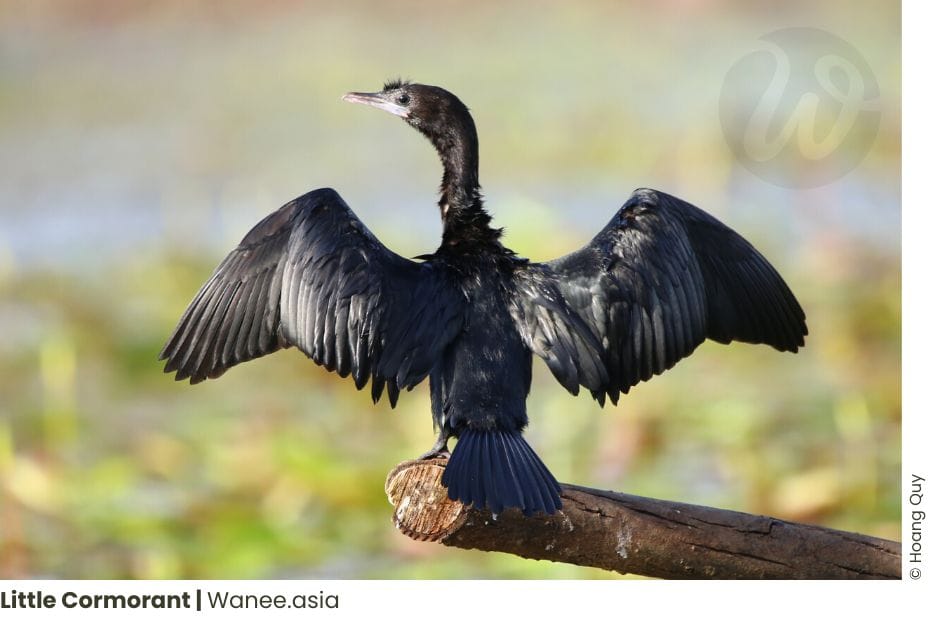
(Microcarbo niger)

(Ceryle rudis)
The longer we stayed on the water, the less we felt the need to move toward individual birds. We could simply let the wetland come to us—the open water, the vegetation, the channels, and the birds moving through them. After a morning of reading the exposed mudflat and searching through shorebird flocks, Tram Chim offered a slower rhythm: a chance to watch, wait, and enjoy the feeling of being surrounded by the wetland as the afternoon gradually moved toward evening.
Waiting for the Light to Change
As afternoon moved toward evening, the quality of the field began to change again. Earlier in the day, heat distortion can become particularly difficult between roughly 09:00 and 14:00, making distant birds harder to identify through a scope. Strong wind can affect scope stability, while heavy rain or unsafe conditions may require a change of plan. By late afternoon, however, we were no longer thinking only about identification. We were watching the landscape settle toward evening.


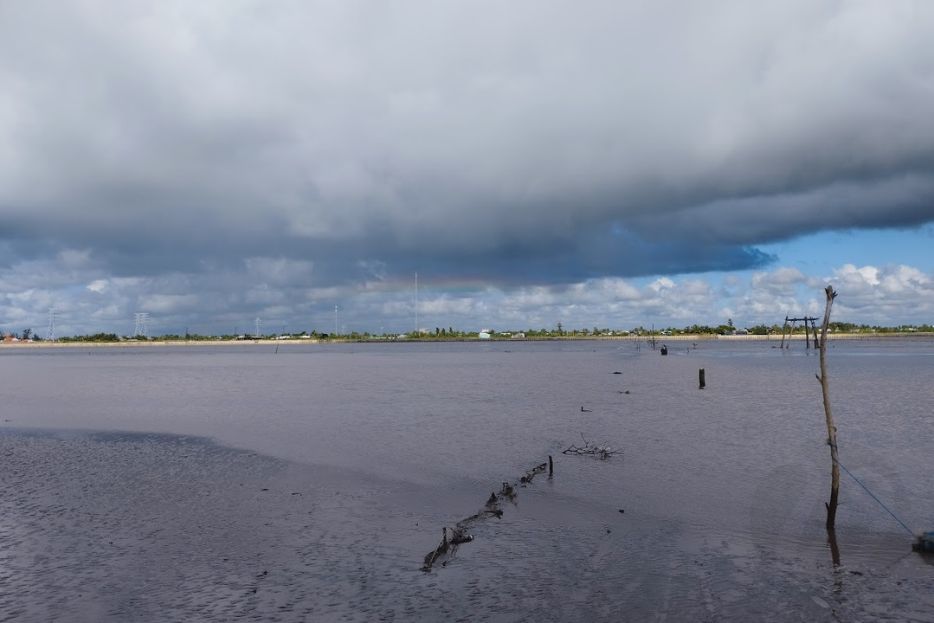
The boat continued through the wetland as the light softened. Then, as the day began to close, the movement across the sky became increasingly noticeable. Birds began returning, one flock following another as they moved across the wetland toward their resting areas. After a morning spent reading exposed mud and searching through shorebird flocks, the evening offered a completely different kind of encounter: not one rare bird hidden among hundreds, but the broader movement of birds returning through the wetland.
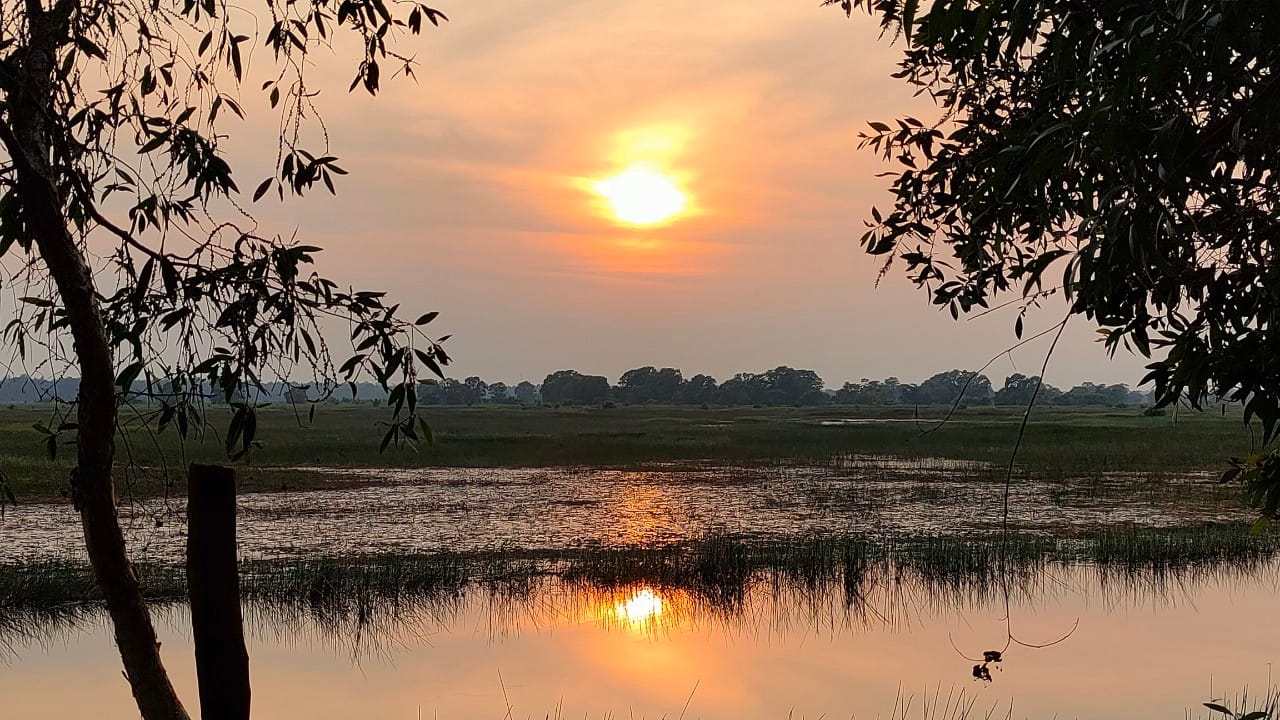
We simply watched.
The day that had begun with a receding tide at Go Cong ended with the wetland filling with movement again.
When the Field Does Not Follow the Plan
A day like this also reminded us that wetland birding rarely follows a perfectly fixed script. At Go Cong, the tide determines when feeding habitat becomes available. At Tram Chim, water levels, weather, access, and the character of the wetland shape what we encounter from the boat. Human activity can change the experience as well.
Fishing activity, clam collection, boats, motorbikes, dogs, tourism groups, and repeated close approaches can displace birds. When this happens, our guide does not chase the flock. Instead, we reposition and try to anticipate where the birds may settle next. Sometimes the best decision is simply to stop moving. A small group moving constantly can create more disturbance than a larger group standing quietly in one place, and that principle followed us throughout the day.
The field does not always give us the encounter we planned for. What matters is how we respond to the conditions in front of us. Sometimes that means changing position; sometimes it means waiting; and sometimes it means accepting that the best view is the one we can achieve without disturbing the birds.
More Than a Checklist
Just one week before this trip, we had conducted an internal survey at the same location and around the same time of year. We searched the mudflat and scanned through the shorebird flocks, but there was not a single sign of a Spoon-billed Sandpiper.
A week later, we returned—and there it was.
The encounter was a reminder of how quickly a wetland can change. Southern Vietnam lies along the East Asian–Australasian Flyway, and although the main shorebird season generally runs from October to early April, with December through March usually offering the most stable wintering populations, the birds’ distribution can still shift with tides, weather, food availability, disturbance, water levels, and migration timing.
That morning at Go Cong, we learned to follow the tide and wait for the mudflat to reveal its birds. By afternoon, Tram Chim changed the rhythm completely, taking us onto the water and into an inland wetland where the day ended with birds returning across the marsh.
The Spoon-billed Sandpiper was an unforgettable highlight, but the greater lesson was simpler: a good wetland birding day is not measured only by how many birds you tick. It is measured by how well you read the field.
For travelers who want to experience Vietnam through field-led wildlife observation rather than a fixed wildlife checklist, Vietnam Wildlife Watching Tours offers a broader approach built around habitats, seasons, animal behavior, and realistic field expectations.
Practical Takeaways
- Plan around the tide: At Go Cong, lower tidal conditions can expose feeding habitat, but the position of the birds still needs to be read in the field.
- Allow time for scanning: Rare species such as the Spoon-billed Sandpiper are possible targets, not predictable sightings.
- Bring the right optics: Binoculars are useful for scanning flocks, while a spotting scope is especially valuable for detailed identification at distance.
- Respect the working landscape: Avoid active clam-farming areas and use acceptable routes across the mudflat.
- Expect conditions to change: Heat distortion, wind, rain, water levels, human activity, and access can all affect the day’s observations.
- Do not chase birds: If a flock moves away, reposition rather than repeatedly approaching it.
- Keep the wider wetland in view: The value of a field day is not limited to one rare species or a checklist.
For a wider seasonal perspective, the WANEE Seasonal Wildlife Guide can help place a potential visit within the broader rhythm of Vietnam’s wildlife seasons.
Continue Exploring
A wetland journey can take very different forms depending on the habitat, season, tide, and field conditions. From coastal mudflats to inland marshes, each landscape offers its own rhythm of observation. For travelers interested in extending the experience beyond shorebirds, Vietnam Wildlife Photography Tours approaches wildlife photography around timing, light, distance, positioning, and ethical field support, while recognizing that wildlife does not guarantee a particular photograph.
For a broader exploration of Vietnam’s birdlife, Vietnam Birding Tours connects different habitats and seasons into field-led birding experiences. These different ways of exploring the country reflect the same principle that shaped our day in the wetlands: the best field experience comes from understanding the conditions rather than expecting the landscape to follow a fixed checklist.
Plan a Mekong Shorebirding Journey Around the Right Field Window
Share your travel dates, target species, birding experience, physical comfort on tidal mud, and preferred pace. Go-WILD will assess the most suitable wetland, tide window, access method, and realistic target expectations.
