

Cat Tien nocturnal wildlife: Entering the Second Shift
Cat Tien nocturnal wildlife is not a niche attraction—it is the operational core of the forest after sunset. To understand Cat Tien National Park fully, one must accept a simple biological fact: humans are temporally mismatched with the rainforest. As diurnal primates, human perception is optimized for light, color, and distance. Yet in the tropical dipterocarp forest of southern Vietnam, daylight hours are often a metabolic compromise for terrestrial mammals. Heat, humidity, and exposure push much of the park’s ground-level biomass into dormancy by day.
What emerges instead is a system of circadian bifurcation. Cat Tien does not function as a single, continuous ecosystem across 24 hours. It operates as two overlapping but behaviorally distinct systems occupying the same physical geography. The “Day Shift” belongs largely to birds, arboreal primates such as gibbons and langurs, and butterflies. The “Night Shift,” beginning around 18:30, belongs to ungulates, carnivores, reptiles, amphibians, and a hidden web of predator-prey interactions that rarely reveal themselves in daylight.
A visitor who retreats indoors after sunset does not simply miss a few additional sightings. That visitor misses the primary active period of the park’s terrestrial ecosystem.
A Forest Designed for Darkness
In the dense semi-evergreen and bamboo mosaics of Cat Tien, daylight can be harsh and energetically costly. Large-bodied mammals such as the Sambar Deer and Gaur retain heat efficiently. For them, midday grazing under tropical sun is metabolically expensive and physiologically risky. Meanwhile, predators conserve energy by resting in shade, waiting for cooler hours.
By dusk, the transformation begins. Bird calls diminish. Cicadas transition. A stillness settles that many interpret as silence. In reality, the forest is recalibrating its sensory hierarchy.
The Cat Tien “second shift” ecosystem is not merely quieter—it is differently organized. Visual signals decline. Acoustic and olfactory cues rise. Predator-prey interactions invert. Darkness becomes protective cover, not absence.

Ⓒ: Luong Hong Pham
This inversion explains why the Cat Tien Night Safari is not an optional entertainment add-on. It is the only structured window into the terrestrial food web in full operation.
Darkness Is a Cover for Activity
The central insight is simple but counterintuitive: darkness does not signal rest. It signals movement.
When the forest appears to “shut down” at dusk, terrestrial biomass is increasing in activity. Bamboo thickets that seemed lifeless in the afternoon now conceal civets slipping between stems. Grasslands that appeared empty at noon host Sambar Deer and Gaur night grazing under cool air. Snakes descend from canopy branches or patrol forest floors in search of amphibians. The park’s ground-level trophic network becomes visible.
The Cat Tien nocturnal wildlife experience reveals predator-prey relationships otherwise invisible. Civets stalk rodents. Pit vipers adopt ambush positions along trails. Amphibians call explosively after rainfall. Herbivores feed in open spaces they avoid by day.
To observe this system is to see the forest’s energy transfer in motion.
Why the Night Shift Exists
Three evolutionary mechanisms drive the nocturnal inversion: thermoregulation, sensory adaptation, and communication restructuring.
1. Thermoregulation: Escaping the Heat
Large ungulates such as the Sambar Deer (Rusa unicolor) and Gaur (Bos gaurus) exemplify thermoregulatory adaptation. With substantial body mass, these animals retain heat effectively. In tropical climates, heat retention can become a liability.
Night grazing allows these species to exploit open grasslands and “grazing lawns” without overheating. By day, they retreat into dense bamboo or forest shade. By night, they emerge onto roadsides and clearings.

Ⓒ: Cat Tien National Park
The frequent observation of Sambar Deer and Gaur night grazing during the Cat Tien Night Safari is not coincidence. It is thermodynamics expressed as behavior.
2. The Tapetum Lucidum: The Biology of Eye Shine
Night observation depends on a remarkable anatomical structure: the Tapetum Lucidum eye shine phenomenon.
Many nocturnal vertebrates possess a reflective tissue layer behind the retina called the tapetum lucidum. This structure reflects incoming light back through the photoreceptors, effectively doubling light exposure and increasing visual sensitivity under low-light conditions.
When a spotlight sweeps across forest edges during a Cat Tien Night Safari, eyes “glow” because of this reflection.
- Red or Orange Eye Shine often indicates crocodiles or certain birds such as nightjars.
- Green or Yellow Eye Shine commonly indicates mammals—deer, civets, leopard cats—and even spiders.


(Petaurista petaurista)
Understanding Tapetum Lucidum eye shine transforms the experience from spectacle to interpretation. A small green reflection at shoulder height differs ecologically from twin orange dots near water level.
Observation becomes identification.
3. Acoustic and Olfactory Shift
Daytime communication relies heavily on visual cues—plumage coloration, body posture, canopy display. At night, sound and scent dominate.
Amphibians respond acutely to humidity. A dry evening may produce near silence. A humid night following rain can trigger explosive choruses from up to nineteen frog species calling simultaneously. Acoustic saturation increases with moisture.
Carnivores such as civets (Viverridae) rely heavily on scent marking and olfactory tracking. In darkness, scent trails persist longer in cooler air. Silence becomes essential—not aesthetic preference, but functional necessity. Noise interferes with predator detection and prey vigilance.

Ⓒ: Thanh Tai – WANEE Vietnam
Entering the Cat Tien ‘second shift’ ecosystem without silence is ecological disruption.
Two Methods, Two Worlds
Experiencing Cat Tien nocturnal wildlife occurs primarily through two structured approaches: vehicle-based Night Safari and guided night herping or walking.
1. The Cat Tien Night Safari (Vehicle-Based)
The Night Safari typically operates between 19:00 and 20:00 using open-top trucks along designated road networks.
The spotlight sweeps forest edges. The first eyeshine appears. Almost inevitably, Sambar Deer stand grazing calmly along roadside verges. Red Muntjac may dart into cover. The calmness of deer under spotlight often surprises first-time visitors, but it reflects adaptation to intermittent illumination rather than vulnerability.
Common sightings include:
- Common Palm Civet (Paradoxurus musanga) moving fluidly through scrub.
- Large Indian Civet (Viverra zibetha) crossing open patches.
- Malayan Porcupine (Hystrix brachyura) rattling quills before retreating.

Ⓒ: Luong Hong Pham
With luck, a Gaur herd may emerge from tall grass. Rarely, a Leopard Cat may be seen hunting.
However, constraints exist. Observation remains confined to road edges. Arboreal specialists and small reptiles remain largely inaccessible. The Night Safari offers breadth but limited depth.
2. Bau Sau Night Herping & Forest Walking
Bau Sau night herping and guided foot treks reveal a different scale of biodiversity.
On foot, the forest becomes intimate. Headlamps reveal eyeshine at close range. Bamboo stems host one of the park’s most iconic nocturnal primates: the Pygmy Slow Loris (Xanthonycticebus pygmaeus).

Ⓒ: Do Doan Hoang
The Pygmy Slow Loris Cat Tien population is frequently encountered during ethical night walks. When illuminated, the loris often freezes, gripping bamboo or branches. Its large forward-facing eyes, adapted to extreme low light, make it vulnerable to improper lighting.
Herpetofauna peak during wet conditions. Night walks reveal:
- Ruby-eyed Green Pit Viper (Trimeresurus rubeus) in ambush posture.
- Banded Krait (Bungarus fasciatus) moving methodically along forest floor.
- Tree frogs such as Polypedates congregating near puddles.

(Trimeresurus rubeus)

(Polypedates leucomystax)

(Bungarus fasciatus)
Humidity dictates intensity. During monsoon months, amphibian choruses can become acoustically overwhelming. This is the operational apex of the amphibian breeding cycle.
Unlike the vehicle safari, night herping provides ecological detail—microhabitats, predator positioning, moisture gradients. It is slower, quieter, and more interpretive.
Predator-Prey Dynamics: Seeing the Food Web
Night observation exposes trophic relationships in real time.
Civets hunt rodents attracted to fallen fruit. Pit vipers position themselves along branches near frog breeding sites. Kraits patrol leaf litter for sleeping reptiles. Ungulates graze where bamboo edges meet grassland.
This is not theatrical drama. It is metabolic exchange.
The forest’s terrestrial biomass becomes spatially visible. Roadsides act as observation windows into otherwise opaque systems. The density of deer and civets along these edges signals ecological health, not artificial concentration.
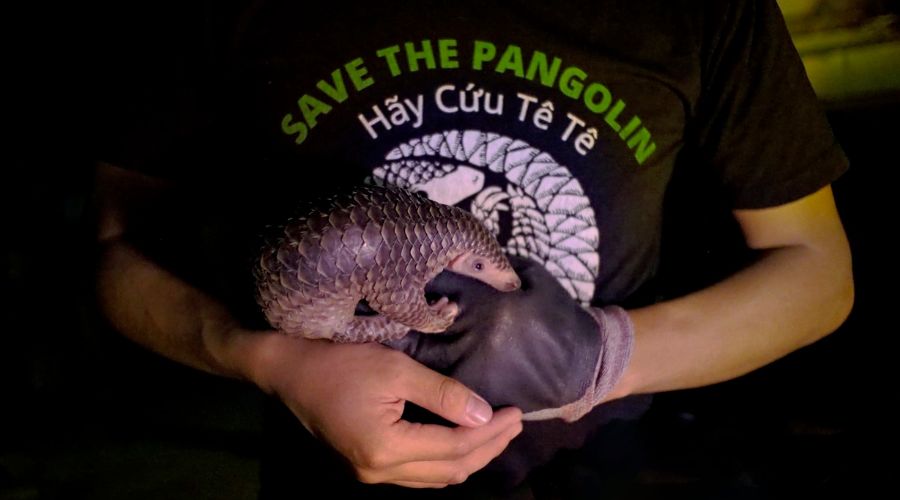
Ⓒ: Save Vietnam’s Wildlife
The rarity of star species such as pangolins or fishing cats should not define success. Abundance of mid-level herbivores and mesopredators indicates functioning protection.
Ethical Wildlife Photography at Night
Accessing the nocturnal world demands ethical discipline.
📸 Flash Prohibition
Ethical wildlife photography night protocols prohibit flash use on nocturnal mammals, especially the Pygmy Slow Loris. Their retinal sensitivity is extreme. Flash can cause temporary blindness, stress, and disorientation. A disoriented loris risks falling or becoming vulnerable to predators.
🔦 Spotlight Discipline
Do not hold high-powered beams directly in an animal’s eyes. Use peripheral light once identification is made. Prolonged direct illumination disrupts hunting and feeding.
🔇 Silence Is Non-Negotiable
Noise travels farther in cool night air. Loud conversation alters behavior patterns and reduces sightings for all. The Night Safari is not a social gathering. It is structured observation.
✔️ Trail Safety
Venomous species—kraits, cobras, vipers—are active hunters at night. Off-trail walking increases risk to both humans and wildlife. Guided treks are mandatory not for convenience, but for safety and minimal disturbance.
Limits & Non-Fit: Managing Expectations
Understanding Cat Tien nocturnal wildlife requires recalibration of expectation.
There is no guaranteed checklist. The forest is not a zoo. Even during peak activity, sightings vary by humidity, moon phase, and seasonal food availability.
Dry season nights favor mammal visibility along water sources. Wet season nights amplify amphibian and reptile activity. Asking “What will be seen?” without context misses ecological nuance.


Scarcity of apex predators during observation does not imply absence. It reflects spatial scale and behavioral adaptation.
The night belongs to patience.
Integration with Seasonal Rhythms
The nocturnal system does not operate in isolation. It interacts with broader seasonal cycles.
Wet season increases humidity, amplifying frog choruses and snake movement. Dry season concentrates ungulates near permanent water, improving Night Safari mammal encounters.
Thus, the Cat Tien ‘second shift’ ecosystem shifts in intensity across months. Night activity reflects hydrological context.
Knowledge Links
• Seasonal Rhythms: The Impact of Monsoons: To understand why the wet season is better for frogs/snakes and the dry season for mammals.
• Ungulate Ecology: Details on the Sambar and Gaur populations you will likely see.
• Herpetofauna of the Monsoon Tropical Forest: A deeper look at the snakes and frogs encountered during night walks.
The Forest’s Operational Peak
The true measure of Cat Tien’s biodiversity is not the morning gibbon call nor the midday butterfly congregation. It is the quiet emergence of deer onto moonlit roads. It is the still silhouette of a civet against bamboo. It is the green glint of Tapetum Lucidum eye shine in peripheral darkness.
Life after dark reveals the forest as energetically alive at ground level.
The majority of terrestrial biomass moves, feeds, hunts, and reproduces when human vision weakens. The Night Safari and Bau Sau night herping are not tourism accessories. They are interpretive tools for accessing ecological truth.
To witness Cat Tien nocturnal wildlife is to witness the forest in its operational peak—a second shift defined not by absence of light, but by presence of adaptation.
To experience this operational peak with ecological depth rather than surface spectacle, WANEE designs field-based night explorations aligned with circadian ecology, humidity gradients, and seasonal detectability windows. Guided by trained naturalists and grounded in conservation ethics, our nocturnal programs prioritize behavioral observation over disturbance, and interpretation over checklist tourism.
Explore our Cat Tien journeys here:
👉 https://wanee.asia/cat-tien-tours/
This Knowledge Asset is based on long-term field observation, official conservation documentation, and peer-reviewed ecological research, synthesized and edited by the WANEE team.