

Cat Tien rainy season vs dry season is not a question of good or bad timing. It is a question of perspective.
In Cat Tien National Park, the forest does not simply change with the weather. It becomes something else entirely. The rainy season and the dry season represent two distinct ecological states – each revealing a different version of the same forest, each essential to understanding how this lowland ecosystem actually works.
For visitors, researchers, and conservation-minded travelers, recognizing the difference between Cat Tien’s seasons is fundamental. It shapes wildlife behavior, trekking conditions, soundscapes, and even how the forest feels to move through. To experience only one season is to read only half the story.
Understanding Cat Tien’s Seasonal Rhythm
Cat Tien lies within Vietnam’s tropical monsoon zone, where rainfall patterns drive ecological processes rather than temperature changes. The forest operates on water.
- Dry season: roughly December to April
- Rainy season: roughly May to October


These shifts determine when animals breed, when plants flower or shed leaves, and when the forest becomes accessible—or deliberately difficult.
Seasonality here is not cosmetic. It is structural.
The Dry Season: Visibility, Structure, and Stillness
From December to April, the forest enters its dry phase. Rainfall decreases, humidity drops, and the landscape becomes more legible.
Leaves thin out. The understory opens. Trails harden underfoot. What emerges is structure.
This is the season when Cat Tien reveals its architecture: canopy layers, tree spacing, termite mounds, and long-used animal paths. For many visitors, dry season Cat Tien trekking feels more approachable – longer walks, firmer trails, and fewer logistical challenges.
Wildlife Patterns in the Dry Season
Cat Tien seasonal wildlife responds clearly to water scarcity.
- Large mammals concentrate near permanent water sources
- Tracks are easier to read in dry soil
- Butterflies gather in large numbers on exposed riverbanks
- Some reptiles bask more frequently in open areas


However, activity levels shift. Amphibians retreat. Many nocturnal species reduce movement. The forest grows quieter.
This stillness is often misunderstood as absence. In reality, it is restraint.
The dry season rewards patience, tracking skills, and attention to detail. Encounters are fewer—but signs are everywhere.
The Rainy Season: Movement, Sound, and Proliferation
When the rains arrive, usually from May to October, Cat Tien transforms rapidly.
The forest closes in. Leaves return in force. The understory thickens. Trails soften or disappear overnight. Temporary streams form where dry ground existed weeks earlier.
With water comes expansion.
Rainy Season Cat Tien Wildlife
Rainy season Cat Tien wildlife is defined by emergence.
- Amphibians appear in large numbers, responding to humidity and breeding cues
- Frogs and toads dominate the night soundscape
- Reptiles become more active and visible
- Insects multiply explosively, driving the food web
- Nocturnal life becomes louder, richer, and more complex

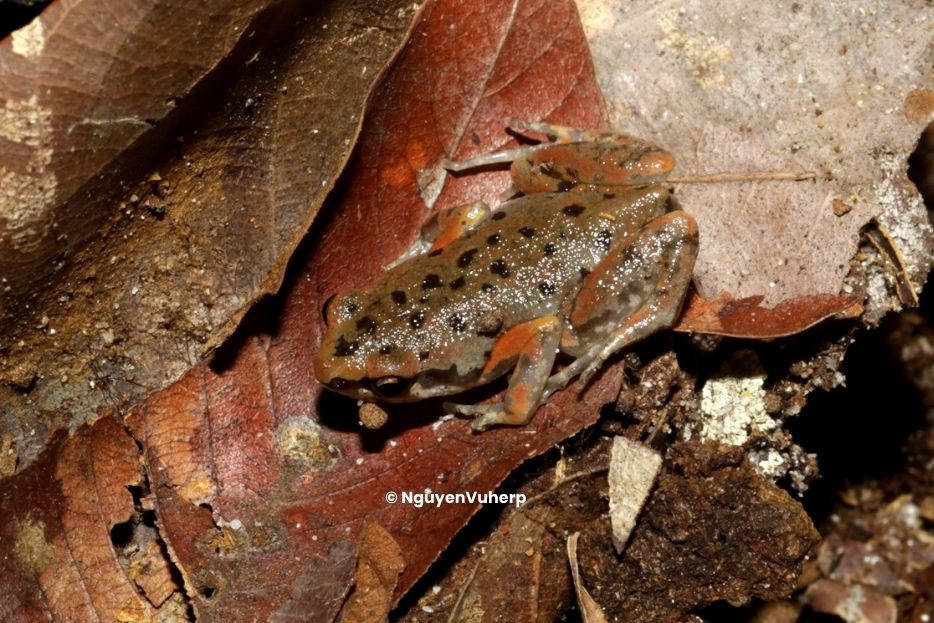

This is the forest at full biological expression.
The rainy season is messy, loud, and unpredictable. Visibility decreases, but life intensifies. You may see less—but you hear and feel much more.
Two Seasons, Two Wildlife Experiences
Rather than asking which season is better, it is more useful to ask what each season reveals.
Dry Season Favors:
- Mammal tracking and spoor identification
- Butterfly concentrations
- Easier trekking and navigation
- Clearer forest structure
Rainy Season Favors:
- Amphibians and reptiles
- Insects and nocturnal life
- Breeding behaviors
- Acoustic richness and ecological interaction
Neither season tells the full story alone.
Understanding Cat Tien rainy season vs dry season means recognizing that each reveals different ecological layers of the same system.
How the Forest Feels, Not Just What It Shows
Beyond wildlife, seasonality shapes experience.
Dry season walks are quieter and more contemplative. Distances feel shorter. The forest invites observation.
Rainy season walks are immersive and demanding. Sounds overlap. Humidity blurs boundaries. Progress slows. The forest demands adaptation.


Both experiences reward those willing to adjust expectations.
Seasonality as a Conservation Reality
Seasonal cycles are not just visitor experiences – they are conservation realities.
Species time reproduction, movement, and survival around rainfall patterns. Disrupting these rhythms disrupts the system itself.
Understanding seasonality is essential to protecting Cat Tien. Conservation here is dynamic, responding to water levels, breeding cycles, and ecological timing – not static protection on paper.
Choosing a Season Is Choosing a Perspective
The best time to visit Cat Tien depends less on comfort and more on curiosity.
- Choose the dry season if you value forest structure, clearer trekking routes, and the ability to read animal signs.
- Choose the rainy season if you are drawn to sound, movement, amphibians, insects, and the forest at its most biologically active.
There is no single “right” season – only different ways of understanding the same ecosystem.
This is why experiences matter as much as timing. Thoughtfully designed programs, such as those operated by WANEE, are built around seasonal ecology rather than fixed expectations, helping visitors engage with Cat Tien’s rhythms in a respectful and informed way.
Learn more about responsible, season-aware Cat Tien tours here:
https://wanee.asia/cat-tien-tours/


To visit Cat Tien twice – once in each season – is not repetition. It is perspective.
Continue Exploring Cat Tien
- Life After Dark: The Unseen Nocturnal Wildlife of Cat Tien
- Mammals of Nam Cat Tien National Park
- Amphibians of Cat Tien: A Rainy Season Phenomenon
- What Conservation Really Means in Cat Tien Today