
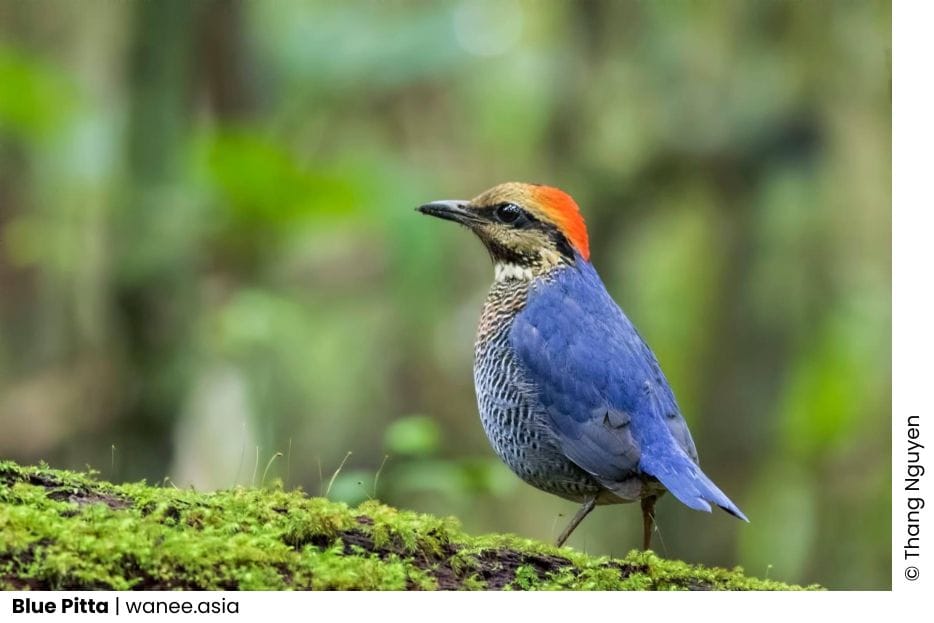
![Itinerary - The Blue Pitta sighted at a birding hotspot in [6-Day] Pittas Photography Tour – Cat Tien - Di Linh - Dalat.](https://wanee.asia/wp-content/uploads/2025/06/Blue-pitta-1067x800.jpg)

Plumage Coloration: The plumage is a study in contrasting hues. As described, the head is adorned with a yellow crown and fiery orange nape. The male's mantle, back, and tail are a stunning sky-blue to azure blue, while the underparts are a paler, polka-dotted blue. Female plumage is more cryptic, dominated by grey-brown tones on the wings and back, with finely barred white underparts that provide camouflage on the forest floor.
Soft Parts: The bird's bill is dark grey. Its legs and feet are pale pink. The iris color is not explicitly detailed in the provided sources but is typically dark in most pitta species.
Juvenile/Immature Plumage: The provided search results do not contain a detailed description of the juvenile plumage for the Blue Pitta. In many pitta species, juveniles have duller, more washed-out colors and less distinct patterning than adults until they undergo their first molt.
Molting: The sources do not specify details about molting cycles for the Blue Pitta. Like most passerines, pittas undergo an annual complete molt after the breeding season, but no significant seasonal plumage changes are mentioned.
Geographic Range: The Blue Pitta has a wide distribution across the northeastern Indian subcontinent, southern China, and Indochina. Its range spans several countries, including India, Bangladesh, Myanmar, Laos, Vietnam, Thailand, Cambodia, and southern China. It is notably common on the Bolaven Plateau in Laos.
Elevation Range: This species demonstrates considerable altitudinal flexibility, occurring from sea level up to about 2,000 meters (6,600 feet).
Habitat Specifics: The Blue Pitta is a forest specialist. Its typical habitat includes lowland and montane moist evergreen forests, particularly those with a dense understory of bamboos. It shows a strong preference for microhabitats near streams and in ravines, where the vegetation is dense and the soil is moist. While it favors moist forests, it can also adapt to drier tropical forests.
Habitat Sensitivity: As a ground-foraging bird that relies on dense, undisturbed forest litter, the Blue Pitta is likely sensitive to heavy habitat disturbance and fragmentation. Its presence can be indicative of healthy, intact forest ecosystems. However, its ability to persist in some drier forests suggests a degree of resilience, though this may vary across its range.

Foraging Strategy & Diet: The Blue Pitta is a diurnal, ground-foraging bird. It is typically solitary, foraging alone by meticulously searching through plant litter on the forest floor. Its technique involves flicking away leaves and probing the ground with its strong bill. Its diet primarily consists of invertebrates, including insects (especially beetles and their larvae), spiders, snails, worms, and grubs.
Breeding Biology:
Nesting: The nest is a large, bulky, dome-shaped structure with a side entrance, skillfully hidden amongst tangled plant growth on the ground.
Breeding Season: Timing varies geographically: May and June in India and Myanmar, and from June to October in Thailand.
Parental Care: Even juveniles forage alone, receiving only occasional visits from their parents, indicating the chicks are likely precocial and receive minimal post-fledging care.
Vocalizations: The species' call is distinctive and often used for detection. It is described as a long, drawn-out, liquid "pleoow-whit" or "choocoo-whip", ending abruptly. These shy birds will often respond to playback of their own call.
Social Structure: Blue Pitta are solitary, shy, and secretive outside of the breeding season. They are typically encountered alone, and even juveniles forage independently.
Conservation Status & Threats:
IUCN Status: The International Union for Conservation of Nature (IUCN) has assessed the Blue Pitta as Least Concern. This status is due to its very wide range and the fact that it is common in suitable habitats over much of its range.
Primary Threats: While not currently threatened, it likely faces pressures common to forest-dwelling species in Southeast Asia, such as habitat loss and degradation from deforestation and agricultural expansion. Its scarcity in parts of its range (e.g., India and China) may reflect local habitat pressures.
Conservation Initiatives: The species is known to inhabit several protected areas, which are crucial for its long-term survival. Continued habitat protection and monitoring are recommended conservation actions.

Send us your ideas and let’s start crafting your unforgettable Vietnam Wildlife experience today.


