

Cat Tien primate niche partitioning explains one of the most remarkable ecological phenomena in Vietnam’s lowland rainforest: how seven sympatric primate species share the same forest without eliminating one another through competition. What appears to visitors as a single, continuous block of tropical habitat is, in reality, a rigidly organized biological apartment complex—divided by height, by diet, and by time.

Ⓒ: Collect
Cat Tien National Park supports an unusually high density of primates not by chance, but through strict ecological specialization. Competition is minimized because the forest is partitioned vertically (by canopy height), temporally (day versus night), and dietarily (fruit versus leaves versus omnivory). Understanding how seven primate species coexist in Cat Tien transforms wildlife watching from passive observation into ecological literacy.
A Seven-Species Stronghold
In many tropical forests, encountering one or two primate species during a field excursion is considered successful. Cat Tien National Park, however, serves as a refuge for seven distinct species—representing a substantial portion of Vietnam’s primate diversity.
This assemblage includes:
- Southern Yellow-cheeked Gibbon
- Black-shanked Douc Langur
- Annamese Silvered Langur
- Pygmy Slow Loris
- Long-tailed Macaque
- Pig-tailed Macaque
- Stump-tailed Macaque
To a casual observer, the forest looks uniform. A single green ceiling. A single trail. A single ecosystem.
To these primates, however, the forest is layered into floors and shifts—much like a high-rise building. Each species occupies a specific level, consumes a specific menu, and operates within a specific time window. This system of Vertical Stratification Cat Tien and dietary divergence is what makes Cat Tien primate niche partitioning possible.
Without this structure, seven medium-to-large primates competing for identical fruit trees would collapse into competitive exclusion.
Instead, specialization sustains diversity.
Diversity Through Specialization
The central principle is simple: diversity persists because each species avoids direct overlap.
The Upper Canopy Specialists—gibbons and doucs—rarely descend. The Generalist Opportunists—macaques—exploit lower strata and disturbed edges. Langurs rely on fibrous leaves that fruit-focused primates ignore. Meanwhile, the strictly Pygmy Slow Loris nocturnal strategy removes it from daytime competition entirely.
A single fruiting fig tree may host different primates in sequence:
- Gibbons at dawn
- Macaques mid-day
- Lorises at night

(Xanthonycticebus pygmaeus)

(Nomascus gabriellae)

(Macaca fascicularis)
The same tree supports multiple lineages because each uses it differently.
This is how 7 primate species coexist Cat Tien without ecological collapse.
Vertical Stratification — The Forest as an Apartment
The forest canopy in Cat Tien ranges between 30–40 meters high. Within this vertical space, primates partition themselves with surprising precision.
The Penthouse (30m+)
The emergent canopy belongs primarily to the Southern Yellow-cheeked Gibbon and the Black-shanked Douc Langur.
These species depend on tall Dipterocarpus and Hopea trees for movement and safety. They are strictly arboreal and vulnerable on the ground.
- Gibbons move via brachiation—arm-swinging locomotion that allows rapid crossing of canopy gaps.
- Doucs rely on agile leaping and controlled landing across branches.

In early morning light, gibbons appear as slender silhouettes against open sky. Males are black. Females are golden. Their locomotion is fluid and uninterrupted.
![Itinerary - [14 Days] The Best Vietnam Wildlife Photography Tour](https://wanee.asia/wp-content/uploads/2025/03/Black-shanked-Douc-4002-1066x800.webp "The Primate Apartment: How 7 Species Coexist in Cat Tien through Ecological Niche Partitioning. 6")
Doucs, in contrast, often sit calmly in upper canopy clusters, digesting leaves. Their white tails and grey-blue bodies flash briefly between foliage layers.
This vertical partitioning minimizes overlap with ground-foraging macaques.
Mid-Story & Understory (5m–20m)
The middle forest layers belong to macaques and the Annamese Silvered Langur.


Although capable climbers, macaques frequently utilize secondary growth, bamboo tangles, and riverine edges. The Cat Tien macaque generalist strategy allows exploitation of transitional habitats where specialists would struggle.


Silvered Langurs prefer dense riparian zones and bamboo thickets. They are often heard before seen—revealed by subtle foliage movement rather than dramatic canopy leaps.
This zone functions as a buffer between upper specialists and terrestrial foragers.
The Ground Floor (0m–5m)
The forest floor is the realm of Stump-tailed and Pig-tailed Macaques.
These semi-terrestrial primates forage for:
- Fallen fruit
- Insects
- Roots
- Small vertebrates
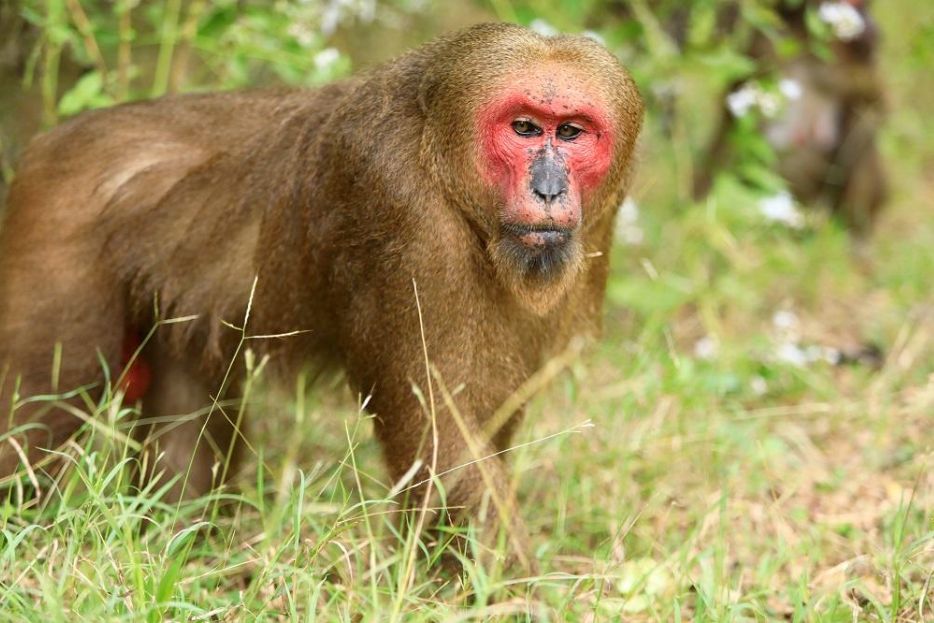
(Macaca arctoides)

(Macaca nemestrina)
Upper canopy specialists rarely descend to exploit these resources. This reduces vertical competition.
The apartment model holds: different floors, different tenants.
Dietary Divergence — Menu Partitioning
If vertical separation were the only mechanism, food competition would still remain intense. Dietary specialization completes the partition.
Frugivores: Energy Hunters
Gibbons are primary fruit specialists. Research in Cat Tien indicates fruit constitutes approximately 43.3% of their diet.
Fruit is energy-dense but patchy. This requires:
- Long daily travel (mean 1.6 km/day)
- Acute spatial memory
- Early morning foraging advantage

Ⓒ: Shirotravel
Gibbons prioritize sugar-rich fruit to fuel their high-mobility lifestyle.
Their ecological strategy is energy maximization.
Folivores: Volume Feeders
Langurs, including the Black-shanked Douc and Annamese Silvered Langur, possess sacculated stomachs similar to ruminants.
These multi-chambered digestive systems allow cellulose fermentation, enabling digestion of fibrous leaves.
Leaves are:
- Abundant
- Ubiquitous
- Less energetically dense but predictable


Annamese Silvered Langur – Ⓒ: QuynhDao Nguyen
This dietary specialization means langurs need not compete heavily for fruit.
They feed slowly, digest slowly, and travel less extensively than gibbons.
Dietary divergence reinforces Cat Tien primate niche partitioning.
Omnivores: Flexible Generalists
Macaques represent dietary opportunism.
They consume:
- Fruit
- Leaves
- Insects
- Crabs (near rivers)
- Small animals

This flexibility allows them to survive in disturbed forest edges and near human-modified landscapes.
The Cat Tien macaque generalist strategy increases resilience but also requires careful visitor management to avoid habituation issues near headquarters.
Circadian Separation — The Night Shift
While apes and monkeys dominate daylight, the Pygmy Slow Loris nocturnal adaptation defines a completely different ecological shift.
By operating exclusively at night, the Pygmy Slow Loris avoids direct resource competition with diurnal primates.
Its diet includes:
- Insects
- Gum and tree sap
- Small vertebrates

Ⓒ: Do Doan Hoang
Movement is slow, deliberate, and silent. When illuminated, lorises freeze—an anti-predator strategy that unfortunately makes them easy to overlook.
Temporal separation completes the partition model:
Day shift: gibbons, langurs, macaques
Night shift: loris
No overlap. Minimal conflict.
Translating Ecology into Sighting Strategy
Understanding Cat Tien primate niche partitioning is not theoretical. It shapes field practice.
☀️ The Gibbon Experience (05:30 – 08:00)
Dawn is essential.
Gibbons sing to mark territory in early morning hours. The forest becomes acoustic before visual.
Tracking begins by locating the call. Only then does scanning the canopy begin.
Without early departure, the opportunity disappears.
🌤️ The Douc Encounter (07:00 – 10:00)
Black-shanked Doucs are quieter but highly photogenic. Look for canopy movement, white tail flashes, or calm clusters digesting leaves.
They are endemic to the region and represent one of Southeast Asia’s most visually striking primates.
🌥️ The Macaque Troop (All Day)
Long-tailed Macaques are frequently observed near rivers and headquarters.
Pig-tailed and Stump-tailed Macaques are encountered along forest trails, particularly routes leading toward Bau Sau.
The Cat Tien macaque generalist presence increases sighting probability but requires ethical distancing.
🍃 The Invisible Silvered Langur
Shy and foliage-dependent, Silvered Langurs reveal themselves subtly. Riparian corridors offer higher success probability.
Patience outweighs speed.
🌙 The Loris Constraint
A Pygmy Slow Loris requires a dedicated night safari or night walk.
Red light is preferred to avoid retinal stress. Flash photography is harmful and discouraged.
The nocturnal shift demands specialized search techniques.
Visibility Limits and Ethical Boundaries
High density does not equal zoo-like visibility.
The canopy reaches 30–40 meters. Neck strain is common. Without 8×42 or 10×42 binoculars, experience quality declines dramatically.


Ethical constraints include:
- No playback or “pishing” to attract primates
- No feeding macaques
- No direct staring or teeth-baring at macaques (interpreted as aggression)
- Maintain safe distance
The forest remains wild. Partitioning works because human interference remains controlled.
Why This System Matters
Cat Tien primate niche partitioning demonstrates that biodiversity stability depends on specialization.
If fruiting patterns shift dramatically due to climate change, gibbons feel impact first.
If bamboo thickets disappear, silvered langurs lose refuge.
If nocturnal disturbance increases, lorises lose temporal safety.
Partitioning is efficient—but delicate.
Seven species coexist not because resources are infinite, but because ecological boundaries are respected.
Integrating Knowledge
This system links directly to broader ecological themes:
- Unlocking the Secrets of Cat Tien’s Primate Species (Detailed profiles of individual species).
- Seasonal Rhythms: The Impact of Monsoons (How fruit availability drives gibbon movement).
- Life After Dark (For the Pygmy Slow Loris experience).
Understanding how 7 primate species coexist Cat Tien strengthens appreciation for lowland rainforest complexity.
Conclusion: A Forest Divided to Survive
The image of a single green forest hides an invisible structure.
- Penthouse brachiators.
- Mid-story leaf digesters.
- Ground-floor opportunists.
- Night-shift insect hunters.
Cat Tien primate niche partitioning is not accidental—it is evolutionary negotiation expressed through vertical space.
Seven species share one forest because each has surrendered part of it.
For wildlife travelers who understand this structure, observation changes completely. The forest is no longer scanned randomly. Eyes move upward at dawn, sideways by mid-morning, and downward as dusk approaches. The canopy, the mid-story, and the forest floor begin to reveal their own rhythms.
Cat Tien stops looking like a uniform green landscape. It becomes layered, rhythmic, and intelligible—an ecological apartment where coexistence depends on specialization.
Guides at WANEE interpret this hidden structure during field excursions, helping travelers read the forest the way ecologists do. Through carefully designed primate-watching experiences, WANEE operates ecotourism with the conviction that responsible travel can strengthen conservation awareness and long-term protection for Cat Tien’s wildlife. Explore our upcoming tour: https://wanee.asia/cat-tien-tours/
This Knowledge Asset is based on a synthesis of long-term field observations, official conservation documents, and peer-reviewed ecological research, edited by the WANEE team.