

Cat Tien birding destination is not defined merely by its impressive checklist of more than 340 recorded species. Its true significance lies in how those species are distributed across a highly structured landscape—a dynamic habitat mosaic of bamboo thickets, semi-evergreen dipterocarp forest, and seasonally pulsing wetlands. This structural complexity allows globally threatened birds and lowland endemics to persist in a region where similar habitats have largely vanished.
Recognized as the ecological anchor of the South Vietnamese Lowlands Endemic Bird Area, Cat Tien National Park protects one of the last intact expanses of lowland tropical forest in southern Vietnam. Unlike montane destinations such as Da Lat, which harbor high-elevation specialists, Cat Tien safeguards species tied to low-altitude ecosystems that have been heavily converted to agriculture and plantations.
Its avian richness—340 to 353 species depending on the source—represents 19 of Vietnam’s 20 avian orders. But these birds are not evenly scattered across the forest. Each species is bound to a specific patch within the larger Cat Tien habitat mosaic. Understanding this mosaic is essential to understanding why this landscape remains one of Southeast Asia’s premier birding sites.
The Habitat Mosaic: Three Forests in One
The diversity of the Cat Tien birding destination emerges from the intersection of three primary ecosystems:
- Riverine wetlands and floodplains
- Secondary bamboo thickets and scrub
- Semi-deciduous and evergreen dipterocarp forest
These habitats overlap and interlock rather than exist as separate blocks. The resulting ecological edges and gradients create specialized niches for birds that cannot survive in simplified landscapes.
Birding here is habitat literacy. Searching for lowland endemics in the wrong patch of forest, no matter how pristine it appears, will lead to frustration. Species distribution is governed by structure, not just canopy cover.
The Bamboo Specialists: Endemism in “Messy” Forest
Among the most emblematic residents of the Cat Tien birding destination is the Orange-necked Partridge. Once believed extinct, it was rediscovered in this park in 1997. Its survival depends heavily on dense bamboo and secondary scrub forests.

©: Vu Minh Tuan
Bamboo stands are often dismissed as degraded or transitional habitat. In ecological reality, they are structural refuges. The layered density provides:
- Deep leaf litter for ground foraging
- Concealment from predators
- Microclimate stability
Without historical disturbance that generated bamboo-dominated zones, this critical endemic might not persist.
The partridge illustrates a fundamental principle: biodiversity does not always favor the tallest, most pristine trees. Sometimes survival depends on structural complexity born from disturbance.
Other bamboo-associated species similarly rely on these dense undergrowth systems. The Cat Tien habitat mosaic therefore includes what might superficially appear “untidy” forest, yet these areas function as endemic strongholds within the South Vietnamese Lowlands Endemic Bird Area.
The Ground-Dwelling Aristocracy: Forest Floor Specialists
Move into semi-evergreen and evergreen forest, and the ecological narrative shifts.
Here reside the pheasants and pittas—birds of color, secrecy, and shadow.
One of the most coveted species is Germain’s Peacock Pheasant, a near-endemic restricted to southern Indochina. It thrives in thorny undergrowth of drier forest types, relying on structural cover rather than open vistas.
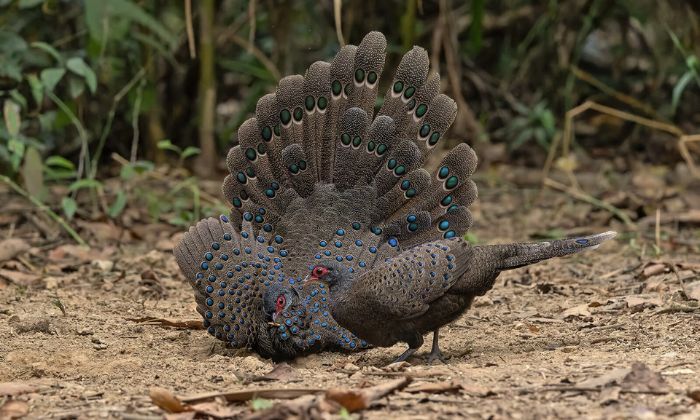
Similarly, the Siamese Fireback requires the open understory of broadleaf forests to conduct social displays. These species depend on intact forest floor complexity—a feature absent from many snare-depleted Vietnamese forests.

The continued presence of these birds reflects relatively successful anti-snare patrols and protection efforts. The Cat Tien birding destination is therefore not only biologically rich but conservation-dependent.
The Wetland Pulse: Abundance Through Hydrology
The Dong Nai River and Bau Sau wetlands create a seasonal rhythm that transforms the landscape.
During the dry season, receding waters concentrate fish, frogs, and invertebrates into shrinking pools. This hydrological pulse supports large waterbirds that cannot survive within closed canopy forest.
Among the most striking is the Green Peafowl. Globally endangered, yet locally observable in grasslands along routes such as C3 and Bau Sau, especially in late afternoon light.

©: Quy Hoang
Large storks such as the Lesser Adjutant and Asian Woolly-necked Stork rely on these wetlands as breeding and feeding strongholds. Their presence underscores Cat Tien’s role as one of the final refuges for lowland megafaunal birds.


The Cat Tien habitat mosaic therefore integrates terrestrial and aquatic productivity. Wetland abundance fuels bird concentrations that contrast sharply with the quiet forest interior.
General Birding vs. Specialist Seeking
Experiencing the Cat Tien birding destination involves understanding two distinct approaches.
General Birding: High Visibility
Certain large species are surprisingly accessible:
- Green Peafowl grazing in open grasslands
- Great Hornbill flying heavily between fruiting Ficus trees
- Oriental Pied Hornbill moving along canopy edges
- Kingfishers along the Dong Nai River
- Grey-headed Fish Eagle scanning from riverside perches

(Lacedo pulchella)

(Buceros bicornis)

(Pavo muticus)
These encounters define the accessible face of the Cat Tien birding destination. Visibility is relatively high, and effort is moderate.
Specialist Seeking: High Difficulty
In contrast, locating skulkers requires discipline.
The Bar-bellied Pitta and Orange-necked Partridge dwell on the forest floor. Silence and seasonal timing are essential. These birds are best detected by call during breeding season.

(Hydrornis elliotii)

(Arborophila davidi)
Serious birders often use hides to observe Germain’s Peacock Pheasant or the Blue-rumped Pitta. Waiting hours in humid conditions becomes part of the process.

(Hydrornis soror)

(Polyplectron Germaini)
The Cat Tien birding migratory season (December–February) adds northern winter migrants, increasing overall diversity. Meanwhile, March–June breeding season amplifies vocal activity but introduces rain, humidity, and leeches.
Understanding seasonal rhythms is critical. Habitat plus timing equals success.
The Role of Seasonality
🦅 Migratory Season (Dec–Feb)
Winter migrants swell the checklist. Species richness peaks.
🪺 Breeding Season (Mar–Jun)
Resident birds defend territories vocally. Detection probability increases. Rain and leeches intensify.
💧Hydrological Shifts
Wetland contraction during dry months concentrates prey, benefiting waterbirds.
Seasonal variation adds a fourth layer to the Cat Tien habitat mosaic: time.
Limits and Realistic Expectations
Despite its reputation, the Cat Tien birding destination is not a zoo.

Birdwatching in Cat Tien NP


Dense tropical foliage obscures visibility. Hearing ten species for every one seen is common. “Warbler neck” from prolonged upward scanning is an occupational hazard.
Playback—recorded calls used to lure birds—remains controversial. While effective, it disrupts feeding and mating. Ethical guiding discourages excessive use, particularly during breeding season.
Seeing pittas and pheasants often requires extended periods inside hides under hot, humid conditions with mosquitoes present. This experience demands patience beyond casual tourism expectations.
Leeches emerge during early wet season—the same time when bird activity peaks.
The forest rewards endurance.
Why Cat Tien Matters Regionally
Within the broader conservation landscape, the Cat Tien birding destination anchors the South Vietnamese Lowlands Endemic Bird Area. Many comparable lowland forests have been converted to plantations, infrastructure, or agriculture.
Montane birding in Da Lat offers different assemblages, but it does not replace lowland biodiversity. These ecosystems are complementary, not interchangeable.
The persistence of lowland specialists—particularly those tied to bamboo or wetland systems—depends on intact habitat mosaics that few regions still retain.
Cat Tien’s value lies not just in numbers, but in representation of a vanishing ecological type.
Field Strategy Summary
Effective birding here requires:
- Habitat identification before species targeting
- Early morning and late afternoon effort
- Seasonal awareness
- Patience in dense understory
- Ethical restraint in playback usage


The Cat Tien habitat mosaic dictates movement. Grassland edges for peafowl. Bamboo for partridge. Wetlands for storks. Tall fruiting trees for hornbills.
Searching randomly wastes energy. Searching structurally yields results.
A Living Mosaic, Not a Static List
The Cat Tien birding destination cannot be reduced to a checklist statistic. It is a living system shaped by hydrology, disturbance history, and vegetation structure.
Bamboo density shelters endemics. Dipterocarp giants feed hornbills. Receding wetlands concentrate fish for storks. Each patch performs a function.
The survival of globally significant species such as the Orange-necked Partridge and Germain’s Peacock Pheasant depends on maintaining this heterogeneity.
Remove one habitat element, and the mosaic fractures.
Knowledge Links
• Top 2 Biodiversity Hotspot in Vietnam for Birder: A comparison between the lowland species of Cat Tien and the montane species of Da Lat.
• Best Tips for How to Photograph Birds in Cat Tien: Technical advice for managing low light in the dense understory.
• Cat Tien NP – A Complete Guide to Explore Wildlife & Nature: Broader context on logistics and access.
Conclusion: Decoding the Landscape
To decode the Cat Tien birding destination is to understand that biodiversity thrives in complexity. The park operates as an intersection of wetland pulse, bamboo density, and semi-evergreen forest structure—three ecological systems interacting continuously across the landscape.
Birding success here depends on reading habitat layers rather than chasing species names. Each patch of forest, wetland edge, or bamboo corridor holds a different ecological story.
Within the South Vietnamese Lowlands Endemic Bird Area, Cat Tien remains one of the most important refuges for lowland avifauna that have disappeared from much of the surrounding region. The forest is not uniform. It is stitched together from ecological fragments that collectively sustain more than 340 recorded bird species, including globally significant endemics and threatened ground birds.

This is not simply a place to see birds.
It is a landscape where habitat mosaic equals survival.
Ecotourism plays a growing role in protecting that complexity. WANEE operates wildlife-focused experiences in Cat Tien while maintaining a conservation-first philosophy, always believing that tourism can become a powerful tool for conservation when guided by ecological knowledge and respect for wildlife. Through guided birding, primate observation, and nature interpretation, visitors gain a deeper understanding of the forest systems that sustain biodiversity. Explore responsible wildlife experiences here:
https://wanee.asia/cat-tien-tours/
This Knowledge Asset is based on a synthesis of long-term field observations, official conservation documents, and peer-reviewed ecological research, edited by the WANEE team.