

A Forest Structured by Water, Not Weather
Cat Tien best time for wildlife is not determined by comfort, clear skies, or trail accessibility. It is determined by energy – specifically how the tropical monsoon redistributes fruit, water, and movement across the forest ecosystem.
In Cat Tien National Park, wildlife visibility follows a hydrological rhythm driven by the Dong Nai River basin. This lowland forest sits at the ecological transition between the southern Annamite foothills and the Mekong plains, creating a sharply defined seasonal cycle:
- Dry season: December – April
- Rainy season: May – November


These seasons do not simply change the landscape visually. They reorganize biological productivity. Fruiting patterns, ungulate grazing pressure, amphibian breeding events, and primate territorial behavior all respond directly to rainfall intensity.
Understanding the Cat Tien best time for wildlife requires shifting from a tourism mindset (“When is the weather good?”) to an ecological one:
Seasonality Determines Behavior, Not Comfort
The central trade-off in monsoon cycle wildlife observation at Cat Tien is ecological, not logistical.
During the wet season, fruit production increases and drives arboreal primates into higher mobility and vocal intensity. During the dry season, shrinking water sources compress terrestrial mammals into predictable zones.
As a result:
- Cat Tien wet season wildlife favors primate observation.
- Cat Tien dry season ungulates become easier to locate.
- Arboreal and terrestrial detectability move in opposite directions.
This inverse relationship defines the real answer to Cat Tien best time for wildlife. There is no universally “best” month. There is only ecological alignment.e for wildlife.
Why the Trade-Off Exists
1️⃣ Southern Yellow-Cheeked Gibbon Behavior and the Energy Budget
The behavior of the Southern yellow-cheeked gibbon provides a clear example of how rainfall restructures visibility.
Wet Season: Fruit Pulse and High Mobility
At 5:45 a.m. in the wet season, before sunrise reaches the canopy, the forest does not feel dramatic — it feels saturated. Humidity settles against the skin. Then, without warning, the first male gibbon call breaks across the valley, echoing from ridge to ridge in overlapping arcs.
By contrast, a March morning in the late dry season carries a different texture. The forest floor is brittle underfoot. Leaves crack softly with each step. Dawn arrives quietly. You may wait twenty minutes before hearing a single primate vocalization.
This contrast is not aesthetic. It reflects a shift in energy flow.
When monsoon rains stabilize, canopy species such as Ficus and Dracontomelon enter fruiting phases. Fruit is calorie-dense but spatially patchy, forcing Southern yellow-cheeked gibbons to travel more frequently between feeding sites. Increased canopy crossings elevate territorial exposure, and dawn vocalizations intensify as neighboring groups advertise occupancy.
Field research in Cat Tien shows fruit can comprise over 40% of gibbon diet during peak availability. Rapid metabolic intake shortens feeding bouts and extends daily movement arcs. In practical terms, this translates into:
- More visible canopy transitions
- Earlier and more layered morning calls
- Higher probability of visual detection along forest edges

Even as trails become muddy and leeches proliferate, primate activity reaches seasonal peaks. For observers focused on gibbon behavior rather than trail comfort, the wet season offers not simply more encounters – but clearer expression of ecological dynamics.
Dry Season: Fallback Diet and Energy Conservation
As rainfall declines, fruit availability contracts rapidly. Gibbons shift toward mature leaves and fibrous plant matter — resources that are abundant but metabolically inefficient. Leaf digestion demands longer processing time and delivers slower energy return.

To compensate, daily travel arcs shorten. Family groups remain within smaller canopy zones, often pausing for extended digestive intervals. Movement becomes intermittent rather than fluid. Although partial leaf fall may open small sightlines through the canopy, reduced locomotion lowers overall detection probability.
In late dry-season mornings, tracking gibbons becomes an exercise in patience. Instead of locating groups by song, observers may rely on subtle cues – a faint tremor in upper branches, a single displaced leaf, or fragments drifting slowly to the forest floor. Silence can stretch for twenty minutes or more between vocalizations.
By contrast, during peak fruit availability, territorial songs frequently begin between 5:30 and 6:15 a.m., with overlapping calls cascading across adjacent ridgelines. The forest shifts from muted intervals to layered acoustic exchange.
What changes between these periods is not visibility alone, but energetic strategy. As caloric return declines, movement contracts – and with it, encounter frequency.
This explains why some visitors during the dry season report “quiet forests” despite good visibility conditions. It is not absence – it is metabolic adjustment. the rainy season.
2️⃣ The Bau Sau Water Constraint and Ungulate Compression
While primates respond to fruit pulses, terrestrial herbivores respond to water distribution.
Species such as the Gaur and Sambar deer are governed by what can be described as the Bau Sau water constraint.
Dry Season: Hydrological Bottleneck
As the dry season progresses, ephemeral streams disappear and interior wetlands shrink. The larger floodplain system contracts dramatically toward permanent basins such as Bau Sau.
This contraction forces ungulates toward reliable water. Spatial distribution compresses. Movement corridors become predictable. Night drives near water sources often yield sambar deer, muntjac, and occasionally gaur.
By late April, as surface water contracts, mud margins around Bau Sau harden into cracked mosaics. Hoof prints overlap densely in narrow corridors leading to the remaining water edge, compressing movement into predictable pathways. In the afternoon heat, the scent of drying sediment becomes noticeable – a signal of hydrological retreat rather than simple seasonal dryness.
This physical compression increases encounter probability. Visibility intensifies not because density rises overall, but because spatial freedom declines.
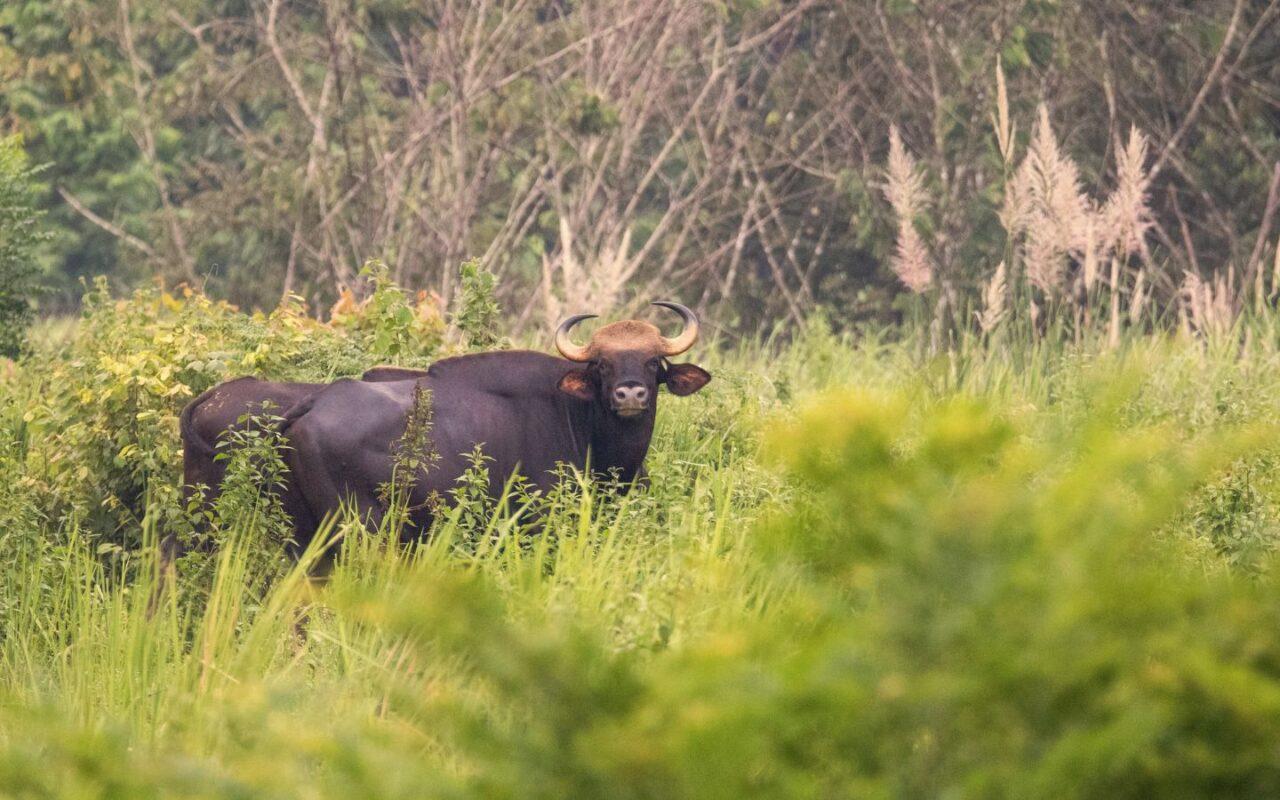


This is why Cat Tien dry season ungulates are frequently easier to observe. The forest is not producing more animals; it is narrowing their options.
Wet Season: Dispersion and Reduced Predictability
When monsoon rains return, water redistributes widely. Fresh bamboo shoots and grasses emerge throughout the forest interior. Ungulates disperse to exploit new forage.
The same corridors that once concentrated tracks dissolve within days. Expanding water margins submerge exposed mud flats, and movement spreads across a broader matrix of accessible habitat. Concentrated hoof patterns disappear as quickly as they formed.
Although overall biomass increases, spatial density decreases. Observers must cover more ground to locate herds. Wet-season wildlife does not disappear – it spreads.


Thus, while Cat Tien wet season wildlife favors primates and herpetofauna, it reduces ungulate predictability through hydrological expansion rather than population decline.
What Each Season Feels Like
Dry Window (December–April)
The forest floor becomes firm and audible underfoot. Semi-deciduous trees shift toward golden tones. Access to Bau Sau remains manageable without deep inundation.
Night drives are productive. Deer species frequently appear along open tracks. The dry forest structure improves mid-range visibility.
However, primate tracking may require extended patience. Reduced vocalization and longer resting periods make detection slower.
Wet Window (June–November)
Humidity intensifies. Moss thickens on trunks. Amphibian breeding activity surges. Reptiles become more active along trail margins.
Gibbons vocalize more consistently at dawn. Movement between fruiting trees increases canopy crossings. For observers focused on primate ecology, this season provides dynamic encounters.
The constraint is physical rather than biological. Cat Tien leeches are common along damp trails. Sudden rainfall may delay vehicle movement. Preparation, not avoidance, is required.
Additional Ecological Layers Often Overlooked
Bird Activity and Insect Pulses
Wet-season insect abundance increases bird foraging activity in certain strata, particularly understory insectivores. Conversely, dry-season thinning improves line-of-sight for raptors and ground-foraging species.

Amphibian Explosive Breeding
Early wet-season storms trigger synchronized amphibian breeding events. Temporary pools fill rapidly, and calling activity intensifies at night. For herpetofauna enthusiasts, this period rivals primate observation in intensity.

Butterfly Mineral Puddling
During transitional rains, large butterfly aggregations form on damp mineral-rich soils. This phenomenon is seasonal and highly photogenic, though short-lived.

These layers reinforce that the Cat Tien best time for wildlife depends on ecological target, not generalized season ranking.
Limits, Non-Fit & Ethical Framing
Seasonality modifies probability, not certainty. Heavy storms may silence gibbons temporarily. Extended drought may push ungulates into atypical patterns.
The wet season is physically demanding. Visitors uncomfortable with mud, humidity, or leeches may find the experience challenging. The dry season, while logistically easier, may feel subdued for canopy-focused observers.
Ethical standards apply equally across seasons:
- No baiting during dry-season concentration periods
- No artificial playback of primate calls
- No spotlight overexposure to resting animals
- Careful foot placement during amphibian breeding
Wildlife visibility must never override ecological integrity.
Why This Trade-Off Matters
The question of Cat Tien best time for wildlife cannot be answered universally.
If your goal is:
- Primate movement and vocal behavior → Wet season
- Ungulate concentration near water → Dry season
- Amphibian breeding events → Early wet season
- Comfortable trekking and broad mammal diversity → Late dry season
Cat Tien is not a safari park operating on a fixed schedule. It is a monsoon-driven forest where fruit pulses and water contraction reorganize movement patterns twice each year.
Understanding this system transforms wildlife observation from passive sightseeing into informed ecological interpretation.
When you align your expectations with rainfall-driven energy shifts, you do not simply increase sightings – you understand why they occur.rom chance encounter to ecological interpretation.
For travelers who want more than seasonal luck, guided interpretation makes the difference. At WANEE, our field approach is structured around the monsoon cycle itself – tracking fruiting pulses, monitoring water contraction at Bau Sau, and adjusting routes based on real-time wildlife movement. Rather than asking when wildlife appears, we position you where ecological conditions make encounters most likely, responsibly and ethically. Explore our field-based programs here:
👉 https://wanee.asia/cat-tien-tours/
Knowledge Links: Expanding the Monsoon System
Understanding the Cat Tien best time for wildlife is only one layer of a larger ecological system. For deeper interpretation, explore these connected knowledge assets:
Primate Assemblage & Seed Dispersal Dynamics
How frugivorous primates influence forest regeneration patterns and long-term canopy composition.
Hydrology of the Bau Sau Wetland Complex
Seasonal flood pulse expansion, nutrient redistribution, and its influence on ungulate density.
Herpetofauna of the Monsoon Forest System
Explosive breeding strategies, temporary pool dependency, and rainfall thresholds.
Together, these layers form an ecological cluster. The monsoon does not simply change scenery – it reorganizes energy pathways across trophic levels.
This Knowledge Asset is based on a synthesis of long-term field observations, official conservation documents, and peer-reviewed ecological research, edited by the WANEE team.