
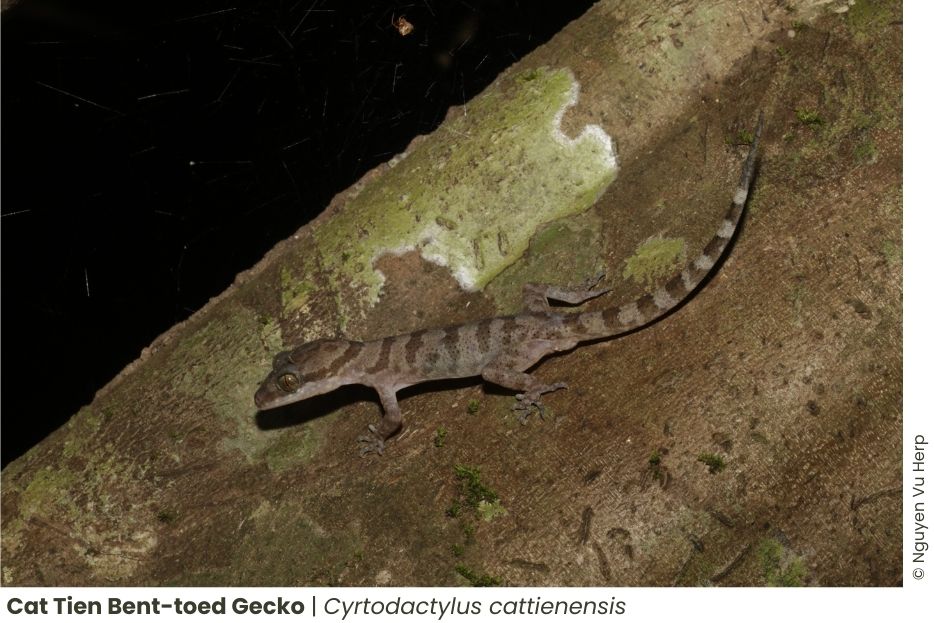
Cyrtodactylus cattienensis is distinguished by its small size, reaching a maximum snout-vent length of 72.4 mm, and distinctive scale characteristics. Key identification features include 8-11 supralabial scales, 8-10 infralabial scales, and 34-40 longitudinal rows of ventral scales. The species displays a distinctive dorsal pattern with 4-5 irregular, dark brown bands between limb insertions, separated by lighter intervals. The tail features 6-7 dark bands that are slightly narrower than the light interspaces. Unlike many related species, it possesses a continuous series of 35-41 precloacal and femoral pores in males, arranged in an angular configuration, which serves as an important diagnostic characteristic separating it from similar bent-toed geckos in the region.
This slender gecko exhibits moderate sexual dimorphism, with males possessing precloacal and femoral pores while females lack these features. The dorsal ground color ranges from light gray to brownish-gray, overlain with dark brown bands that are edged with white tubercles. The head shows a distinctive dark pattern with a light interorbital band and dark brown postorbital stripes. The ventral surface is cream-colored with some dark speckling on the throat region. The original tail displays alternating light and dark bands, with the dark bands being slightly narrower than the light intervals. The limbs are moderately long with distinctive subdigital lamellae numbering 15-18 under the fourth toe, adaptations that facilitate climbing on various surfaces within its forest habitat.
yrtodactylus cattienensis is restricted to Cat Tien National Park in Dong Nai Province, southern Vietnam, where it inhabits lowland evergreen forests at elevations of approximately 100-150 meters above sea level. The species shows a preference for specific microhabitats including the vicinity of rocky streams, areas with dense leaf litter, and the base of large trees. Within these habitats, individuals are typically found on the ground or on low vegetation, rarely venturing high into the canopy. The gecko's distribution appears limited to the park's core areas with minimal human disturbance, though some individuals have been recorded in slightly degraded habitats adjacent to primary forest. The type locality represents a relatively flat area with mixed deciduous and evergreen vegetation, characterized by a dense understory and abundant leaf litter accumulation
This nocturnal gecko emerges after dusk to forage for small invertebrates, primarily feeding on insects and arachnids. During daylight hours, individuals seek refuge under leaf litter, in rock crevices, or at the bases of trees. Little is known about its reproductive biology, but like other Cyrtodactylus species, it is presumed to be oviparous, laying small clutches of 1-2 eggs in moist, concealed locations. The species appears to be relatively sedentary, with individuals maintaining small home ranges within suitable microhabitats. When threatened, the gecko relies on its cryptic coloration to avoid detection, remaining motionless against leaf litter or tree bark. During the dry season, individuals may retreat to more humid microhabitats near water sources to avoid desiccation.
Send us your ideas and let’s start crafting your unforgettable Vietnam Wildlife experience today.


