The Blue-rumped Pitta is a true "forest ghost" and a highly prized target for birdwatchers in Southeast Asia. This ground-dwelling beauty is famous for its ability to melt into the shadows, only revealing a sudden, breathtaking flash of its brilliant blue lower back when it hops
. Often found in the deep, moist jungles of Cat Tien National Park and the highlands of the Annamites,
Status: Near Endemic
IUCN: Near Threatened
Diet: insectivore
Group:
Size: 20 cm
Lifespan: 7 years
Sighting: Fairly Common
To identify a Blue-rumped Pitta hidden within the thick forest floor, look for these specific features:
Size & Build: It is a medium-sized, plump bird, measuring about 18–20 cm in length and weighing between 55 and 88 grams. Like all pittas, it has a rounded body, long legs for hopping, and a very short tail.
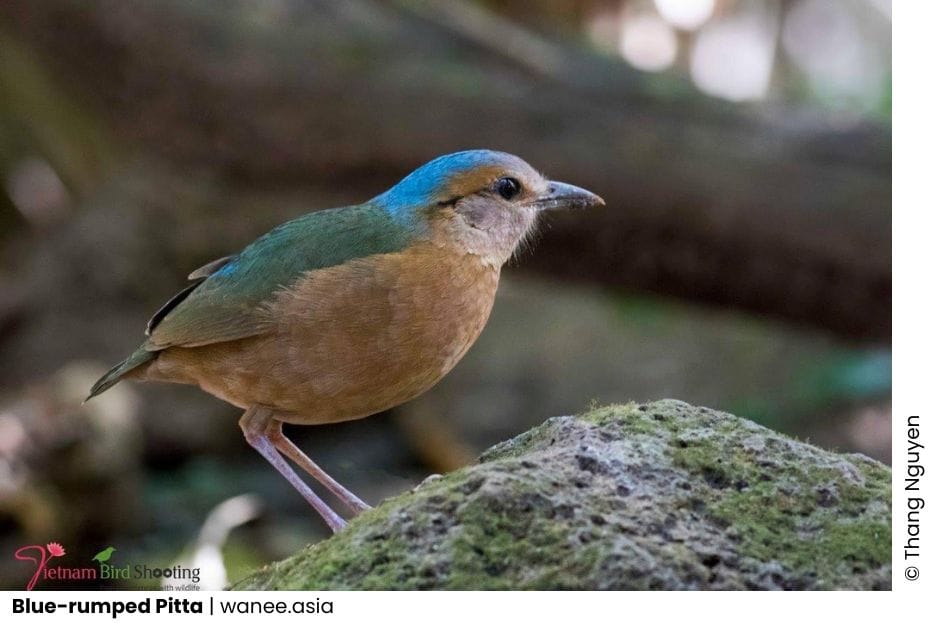
Key Marks: It is easily recognized by its rich chestnut-brown head and back, which contrasts sharply with its most famous feature: a shimmering blue rump (lower back). It also has a subtle pale blue stripe above its eye.
Similar Species: It is often confused with the Rusty-naped Pitta, but the Blue-rumped species is characterized by its blue rump and much pinker tones on its underparts.
Subspecies: In Vietnam, you may encounter different regional variants, such as petersi in the North (Tonkin) and annamensis in the Central and Southern regions.
The Blue-rumped Pitta displays a sophisticated mix of earth tones and vivid highlights:
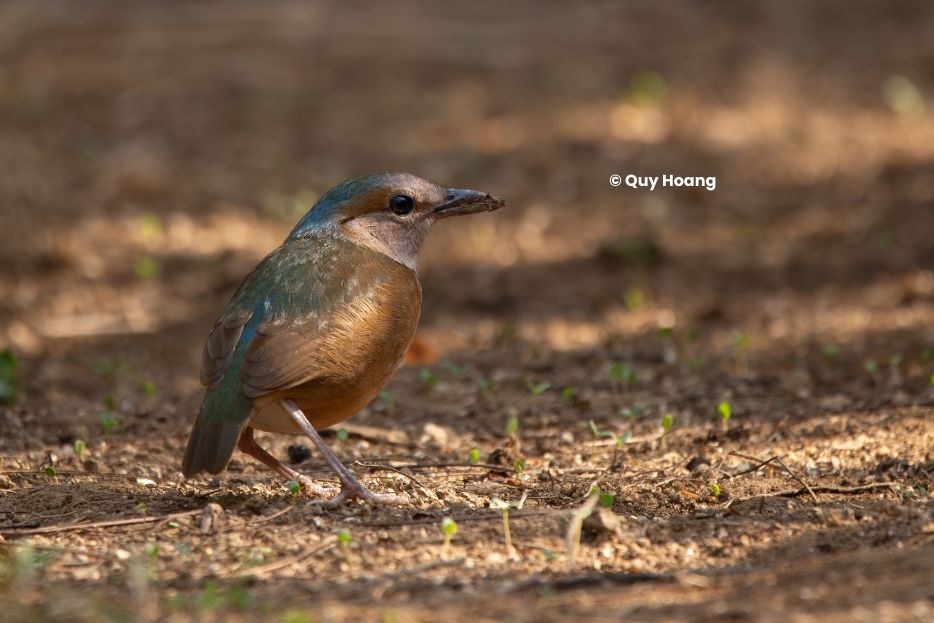
Plumage Colors: Its head is a greenish-brown to reddish-brown color, while its back is a deep chestnut. The wings show a beautiful mix of greens and blues, and its belly ranges from a soft whitish-buff to deep brown.
Soft Parts: It possesses a sturdy, slightly curved black bill and robust, pale pinkish legs specialized for navigating the forest floor.
Male vs. Female: There is very little difference between the sexes. Both share the vibrant blue rump, though males may occasionally be slightly larger or display more intense coloring.
Juveniles: Young birds look much more modest, wearing a mix of brown and olive tones with a muted blue rump that only brightens as they grow older.
This bird is a loyal resident of the dense jungles across Indochina:
Geographic Range: It is native to Southeast Asia, specifically Vietnam, Laos, Cambodia, Thailand, and parts of Southern China. It is considered a "Fairly Common" resident in areas like Cat Tien.
Elevation: They have a wide range, living from sea level up to 1,500 meters (and occasionally recorded at 1,700 meters in northern Vietnam).
Habitat Specifics: Their absolute favorite homes are moist evergreen forests and secondary jungles with heavy undergrowth and a thick layer of fallen leaves.
Habitat Sensitivity: Because they rely on undisturbed forest floors, they are threatened by habitat destruction from logging and farming. Seeing them is a sign of a healthy, protected forest ecosystem.
Blue-rumped Pitta, a common resident bird in Vietnam's subtropical and tropical forests, particularly in lowland and montane areas.
No data was found
The Blue-rumped Pitta has fascinating secretive habits and musical talents:
Foraging & Diet: They are primarily insect-eaters. They spend their day hopping quietly, using their strong bills to flip over dead leaves to find ants, beetles, worms, and caterpillars.
The Forest Whistle: They are more easily heard than seen. Their call is a distinctive, clear whistle, often described as a short "tu-wi-whit" in some regions or a longer "weaoe" repeated every few seconds. These calls peak during the wet season between May and August.
Breeding Biology: They form monogamous pairs during the breeding season from April to June. They build simple, cup-like nests hidden very low to the ground in shrubs or mossy areas for camouflage. Both parents work together to incubate the 2–3 eggs and feed the chicks.
Conservation Status: They are currently classified as Near Threatened.




![[1-Day] Ma Da Birding Tour](https://wanee.asia/wp-content/uploads/2025/06/bird-tour-3.jpg "[1-Day] Ma Da Birding Tour 4")