Black-headed Parrotbill - Paradoxornis margaritae

Paradoxornis margaritae
Near-endemic to Vietnam’s Central Highlands, the Black-headed Parrotbill is a Vulnerable passerine confined to the Da Lat Plateau. Discovered in 1927 and long feared extinct until its dramatic rediscovery in 1994, this species epitomizes Vietnam’s avian endemism crisis. It thrives in dense bamboo thickets within montane forests.
Status: Near Endemic, Restricted Range
IUCN: Vulnerable
Diet: Herbivore
Group: bird
Size: 15.5 cm
Lifespan: 8 years
Sighting: Occasional

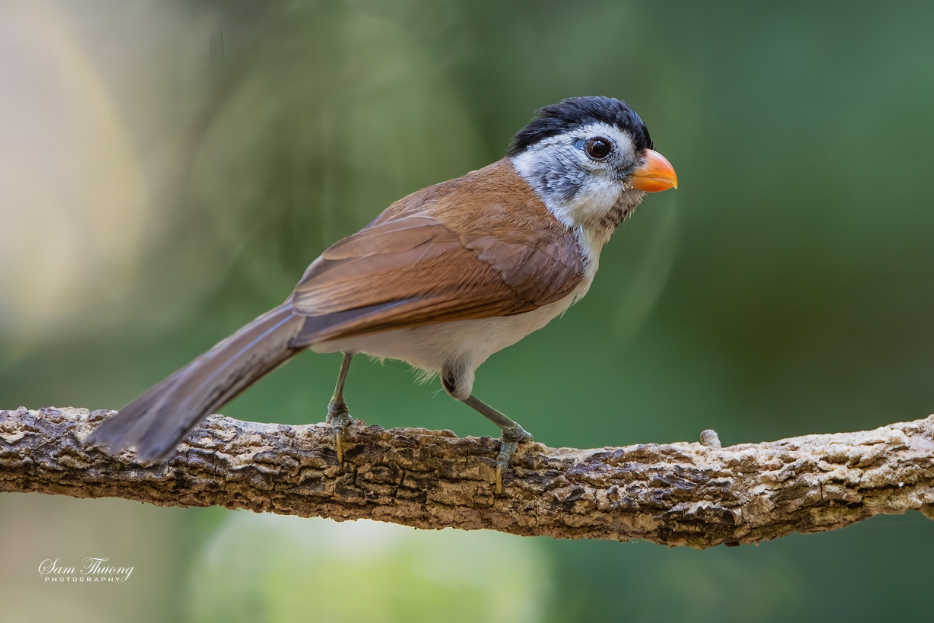
This small (15 cm), gregarious bird is unmistakable: adults display a jet-black head contrasting sharply with a warm brown back and bright rufous-buff underparts. The thick, parrot-like orange-yellowish bill—adapted for prying bamboo—and pale eyes create a distinctive facial profile. Vocalizations include sharp “tchik-tchik” contact calls and melodic duets within flocks, often described as “see-sip, see-sip".

Sexual dimorphism is minimal. Adults feature uniform black crowns and napes extending to the throat, offset by cinnamon-brown upperparts and rich buff underparts. The stout, curved yellow bill and pale gray legs are adapted for bamboo manipulation. Juveniles show muted colors: grayish-brown heads, olive-tinged backs, and yellowish bills. In flight, short rounded wings and a long, graduated tail aid maneuverability through dense vegetation

Exclusively found in Vietnam’s Da Lat Plateau (Lam Dong and Dak Lak Provinces), this parrotbill inhabits montane evergreen forests at 900–1,500 m elevation. It favors steep slopes with dense bamboo understories (Chimonobambusa spp.), particularly near streams and ravines. Key sites include Bi Doup–Nui Ba National Park and Ta Nung Valley. Distribution is highly fragmented due to habitat loss, with populations isolated in forest remnants covering less than 2,500 km² globally .

Destination_guide - Bird distribution.

Black-headed Parrotbills forage in flocks of 6–12, acrobatically probing bamboo stems and leaf sheaths for insects, spiders, and small seeds. Their specialized bills pry open bamboo to access hidden arthropods. Breeding peaks March–July; monogamous pairs build deep cup nests in bamboo clumps using moss, fern fibers, and spiderwebs. Females lay 2–3 white eggs, incubated for 12–14 days. Chicks fledge at 14 days but remain with family groups for months. Social cohesion is maintained through contact calls and allopreening, with flocks defending year-round territories.

Related Species

Related tour

No related tours yet...

Ready for your adventure in Vietnam?

Send us your ideas and let’s start crafting your unforgettable Vietnam Wildlife experience today.

UX/UI