
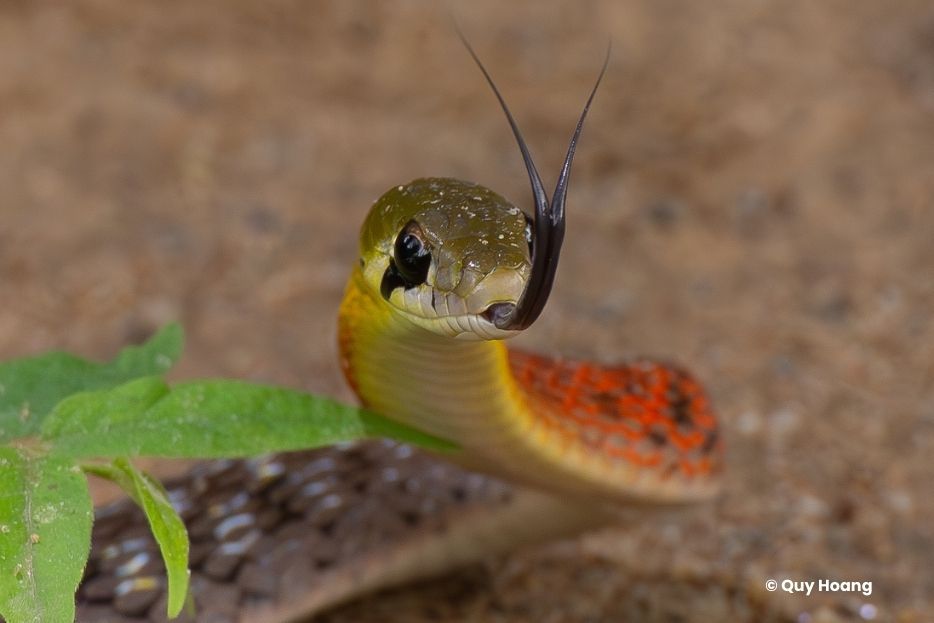
Size & Build: This is a moderate-sized, slender snake. While specific measurements for R. siamensis are not detailed in the provided sources, its close relative R. subminiatus grows to a total length (including tail) of 70 to 90 cm (27.5 to 35.5 inches) . R. siamensis likely falls within a similar size range, possessing the characteristic streamlined, agile build typical of keelback snakes, adapted for both terrestrial and semi-aquatic life.
Key Field Marks: The most prominent feature is the bright red or orange-red coloration on the neck, which is the source of its common name . The dorsal ground color is typically a greenish or olive hue . When threatened, individuals may flatten their necks to better display this vivid warning coloration .
Sexual Dimorphism: Clear sexual dimorphism in size is noted in the genus. Females are significantly larger than males . During the breeding season, multiple males may swarm a single female . Extreme sexual dichromatism (color difference), as documented in the related R. leonardi, has not been specifically reported for R. siamensis but cannot be ruled out .
Similar Species: It is most easily confused with its closest relatives within the Rhabdophis subminiatus complex, from which it has been recently separated taxonomically . It may also be confused with other non-venomous keelbacks. The key differentiating trait is its combination of a distinct red neck, keeled dorsal scales, and its status as a rear-fanged venomous species. The related Heller's Red-necked Keelback (Rhabdophis helleri), now considered a full species, may have overlapping ranges and requires expert examination for differentiation
Coloration & Patterning: The head and anterior body are marked by the signature red or orange-red patch on the neck . The dorsal ground color ranges from greenish to olive, sometimes with darker checkering or flecking along the length of the body . The belly is typically a lighter yellow or cream color . The head is slightly distinct from the neck, with round-pupiled eyes that are dark in color .
Scalation & Physical Features: As a "keelback," it has keeled dorsal scales (each scale has a raised ridge). It possesses the genus-defining features of large eyes with round pupils and enlarged rear maxillary teeth (fangs) located posteriorly in the mouth for venom delivery . A critical morphological feature is the presence of nuchal glands—specialized structures on the neck that store defensive toxins .
Juvenile/Immature Coloration: Juveniles generally exhibit similar patterns to adults but often with brighter and more defined colors . In the related R. helleri found in Hong Kong, the head color transitions from dark grey to olive green with maturity, and a yellow collar present in juveniles may fade .
Melanism and Variation: Significant variance in coloration can occur. Extreme melanism (where the snake is entirely black) has been observed in the related R. helleri, indicating that color alone is not an absolute identifier and caution is needed .
Geographic Range: Rhabdophis siamensis is endemic to mainland Southeast Asia. Its core distribution, as implied by its epithet, includes Thailand . It is also documented in southern China . Its range likely encompasses parts of the adjacent Indochinese region.
Distribution in Vietnam: North
Elevation Range: Species within this genus can be found across a wide altitudinal range. The related R. leonardi is frequently found at 1,730–2,230 m in southwestern China, indicating an adaptation to montane environments . R. siamensis likely inhabits both lowland and mid-elevation areas.
Habitat Specifics: This species is strongly associated with humid environments near water. Its typical habitats include wetlands, forest streams, ponds, and moist evergreen forests . It is a diurnal (day-active) and terrestrial snake that is often found in areas with ample cover .
Habitat Sensitivity: As a predator reliant on amphibian prey and specific microhabitats near water, it is sensitive to habitat destruction, pollution, and the drainage of wetlands. Its presence is a good indicator of a healthy, intact aquatic ecosystem.
Foraging Strategy & Diet: It is an active, diurnal forager. Its diet primarily consists of amphibians, especially frogs and toads . This dietary preference is ecologically crucial as it sequesters potent bufadienolide toxins from consumed toads and stores them in its nuchal glands, making it poisonous . It may also consume fish, lizards, and small mammals .
Venom and Poison Defenses: This species possesses a rare dual chemical defense system.
Venom: It is a rear-fanged (opisthoglyphous) venomous snake. Its Duvernoy's gland produces a venom that is highly toxic and potentially lethal to humans, containing procoagulants that can cause severe coagulopathy, internal hemorrhaging, and kidney failure . Although envenomations are rare due to its rear-fanged anatomy, they are medically significant and require urgent treatment, potentially with specific antivenom .
Breeding Biology: The species is oviparous (egg-laying) . Mating behavior involves multiple males swarming a single, larger female . Specifics on clutch size, incubation, and nesting sites for R. siamensis are not detailed in the provided sources.
Social Structure: It is typically a solitary animal outside of the breeding season. The swarming behavior during mating is a notable exception .
Lifespan: As a medium-sized colubrid snake, its natural lifespan can be estimated to be in the range of 5 to 10 years, though this is speculative and varies with environmental pressures and predation.
Send us your ideas and let’s start crafting your unforgettable Vietnam Wildlife experience today.


