
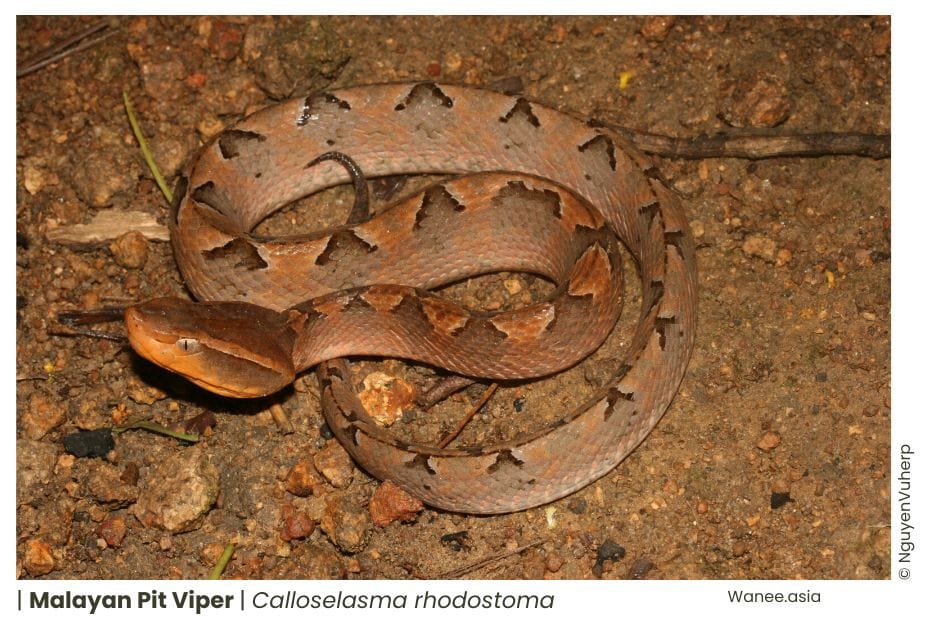
Calloselasma rhodostoma is distinguished by the following key features:
Medium size, with adults averaging 76 cm in length (females slightly larger) and reaching up to 91 cm .
Triangular head with a pointed, upturned snout and heat-sensing loreal pits between the eyes and nostrils .
Smooth dorsal scales arranged in 21 rows at midbody, a trait unique among Asian pit vipers .
Coloration varies geographically: reddish, grayish, or pale brown dorsally with two series of large, dark brown, black-edged triangular blotches. A thin dark brown vertebral stripe may be present but is often interrupted .
Distinct facial markings: a broad, dark brown, black-edged diagonal stripe from the eye to the corner of the mouth, accompanied by a narrower light-colored stripe above it .
Ventral scales yellowish with grayish-brown spotting or powdering .
Tail short and stout, accounting for ~11% of total body length .
Sexual Dimorphism: Females are generally longer and heavier than males, though both share similar coloration and scalation patterns .
Scalation Details:
Ventrals: 138–157
Subcaudals: 34–54 pairs
Anal plate: Entire
Head scales: Two internasals, two prefrontals, and 7–9 upper labials .
Regional Variations:
Vietnamese specimens (sometimes classified as C. r. annamensis) may exhibit darker dorsal blotches and a more pronounced vertebral stripe .
Juveniles resemble adults but with brighter contrast in patterns and slightly keeled scales that smooth with age .
Widespread across Southeast Asia, including Thailand, Cambodia, Laos, Vietnam, northern Malaysia, and Java (Indonesia) .
In Vietnam, it is particularly abundant in South Central Coastal regions (e.g., Dong Nai Province) and lowland areas .
Habitat Preferences:
Lowland forests, bamboo thickets, coastal scrub, and agricultural areas (e.g., rice paddies, rubber plantations) .
Often found near human settlements due to prey availability (rodents) .
Elevation range: Sea level to 2,000 meters, though most common below 700 meters .
Microhabitat: Prefers moist, shaded ground cover, leaf litter, and rocky outcrops for ambush hunting .
Diet and Foraging:
Primarily feeds on small mammals (rats, mice), frogs, lizards, and occasionally birds .
Uses ambush predation, relying on camouflage and immobility to surprise prey .
Nocturnal activity peaks during early night, though may forage diurnally in cloudy weather .
Reproduction:
Oviparous: Lays clutches of 6–20 eggs in concealed nests (e.g., leaf litter, rotting logs) .
Female parental care: Guards eggs until hatching (~60 days) .
Breeding season coincides with monsoon rains (May–June in Thailand) .
Defensive Behavior:
Highly irritable and quick to strike when provoked .
Often remains motionless after biting, leading to repeated human encounters in the same spot .
Send us your ideas and let’s start crafting your unforgettable Vietnam Wildlife experience today.


