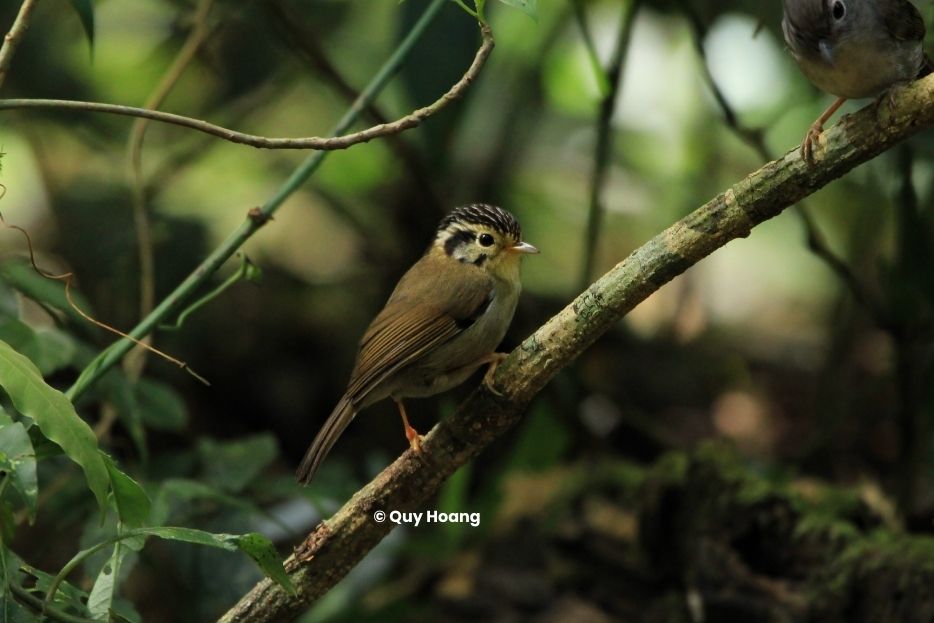
Measuring 13–14 cm, the Black-crowned Fulvetta Alcippe klossi is easily identified by its black crown and nape, contrasting sharply with chestnut ear coverts and a grey face. The upperparts exhibit bold black-and-white barring on the wings and back, while the underparts transition from streaked grey on the throat to soft buff on the belly. A diagnostic white-tipped tail with a broad black subterminal band is conspicuous in flight. Juveniles display duller plumage with less defined barring. Vocalizations include melodious warbles and sharp, rasping alarm calls used for flock cohesion
This species showcases minimal sexual dimorphism, though males may have slightly bolder head patterns. Adults feature a complex color palette: the black crown extends to the nape, offset by chestnut "cheeks" and a bluish orbital ring. The stout, slightly curved bill is dark gray, and legs are pale orange. Wings and back display irregular black-and-white barring, providing camouflage in dappled forest light. Juveniles are browner overall, lacking the vivid crown and ear patches until their first mol
Exclusively found in Vietnam’s Da Lat Plateau (Langbian Highlands), this fulvetta inhabits montane evergreen forests at 800–1,750 m elevation. It favors dense understory, bamboo thickets, and stream corridors in protected areas like Bi Doup–Nui Ba National Park. The species avoids degraded or open habitats, relying on contiguous forest cover for foraging and nesting. Its global range is among the smallest of any bird, confined to an area of less than 20,000 km² in southern Annam.
Typically observed in pairs or small flocks, this fulvetta forages terrestrially, scratching leaf litter for insects, spiders, and seeds. monogamous pairs build cup-shaped nests low in ferns or shrubs, using moss, twigs, and fern fronds. Females lay 2–3 eggs, incubated by both parents for approximately 14 days. Chicks fledge within weeks but remain dependent on parental care for months. The species employs a "freeze-and-flee" anti-predator tactic, relying on camouflage to evade detection. Its fluid, whistling song—often incorporating mimicry—facilitates social bonding and territory defense.
Send us your ideas and let’s start crafting your unforgettable Vietnam Wildlife experience today.